The Low‑Carbon Future
Asphalt is used on over 95% of UK roads, and over 25 million tonnes of asphalt are produced annually in the UK. That matters, because the UK also faces an £18.6bn local road maintenance backlog, while the UK Government has a legal net zero commitment for 2050 and National Highways is targeting net zero maintenance and construction by 2040 through its Net Zero Highways plan. Traditional hot asphalt and older tarmac practices cannot stay “business as usual” if councils, developers and estates teams want credible ESG reporting.
This is a practical sustainability view of Tarmac & Asphalt Surfacing: what to specify, where carbon is hidden, and why durable tarmac for commercial use often beats the cheapest quote over real pavement life.
The Carbon Challenge of Traditional Asphalt and Tarmac
Asphalt production is a major embodied-carbon issue because asphalt mixes need dried aggregate, heated bitumen binder, haulage, paving, rolling and later maintenance. Published UK product data often puts typical asphalt around 40–75kgCO₂e per tonne, while wider construction materials datasets show many hot-mix systems can sit higher depending on fuel, transport and binder; the policy direction is clear in the UK Industrial Decarbonisation Strategy.
The biggest emissions usually come from heating stone, sand and gravel, then mixing petroleum-derived bitumen at high temperature, though some paving and maintenance mixes also include a small cement component alongside the binder. Add lorry movements, site plant, compaction and resurfaced failures, and a weak road surface can become a repeating carbon bill. Over 25 million tonnes of asphalt are produced annually in the UK, so small percentage savings become very large.
The language also matters. Tarmac specifically refers to tar-based mixtures; tarmac consists of crushed stone mixed with tar, and it was patented in 1902 by Edgar Purnell Hooley to solve dust issues of early macadam roads. Traditional tar-based versions of tarmac are largely obsolete because tar can contain hazardous PAHs. The term ‘tarmac’ is often used to refer to modern asphalt, but modern asphalt roads are constructed in layers from aggregates and bitumen rather than made with tar.
Asphalt Concrete Fundamentals: What You’re Really Buying
Asphalt concrete is a mixture of mineral aggregate and bituminous binder, mixed hot or warm, laid and compacted in layers: base, binder course and surface layer. AC 32 base carries weight, AC 20 binder spreads load, and AC 10 surf or another surface course gives grip, appearance, drainage control and protection.
Modern tarmac driveways, car parks and footpaths are generally bituminous macadam or asphalt surfaces. Tarmac is used primarily for the top layers of roads in everyday language, while engineers specify various grades of asphalt concrete, Stone Mastic Asphalt, Hot Rolled Asphalt and Porous Asphalt. Hot Rolled Asphalt (HRA) is used for higher-speed roads, Stone Mastic Asphalt (SMA) is known for high deformation resistance, and Porous Asphalt (PA) allows water to drain through the pavement.
Additives change properties. Polymer binder can resist heavy traffic, warm mix technology lowers temperature, fibres stabilise the mix, crumb rubber from tyres can be recycled into road contracting materials, and reclaimed asphalt can be re used in new pavements. Asphalt concrete is recyclable and can contain a range of reclaimed or secondary inputs.
Innovations in Low‑Carbon Surfacing: Warm Mix, Recycled Content and Cold‑Lay
The industry is making progress by cutting heat, using a high proportion of recycled material and choosing the right treatment for the right site. Warm mix asphalt uses chemical, foamed or organic technology to lower production and laying temperatures by about 20–40°C. Warm mix can reduce CO₂ by up to about 15% against equivalent hot mix, while improving weather conditions tolerance, reducing fumes, and widening the compaction window.
Circular content is the next lever. RAP can be suitable in base, binder and sometimes surface courses, commonly around 10–50% depending on specification and risk. Secondary aggregate, steel slag, recycled glass sand and crumb rubber all have a role, but only if wheel-tracking, stiffness and fatigue cracking checks prove the mix will not rut or crack early under traffic and vehicles.
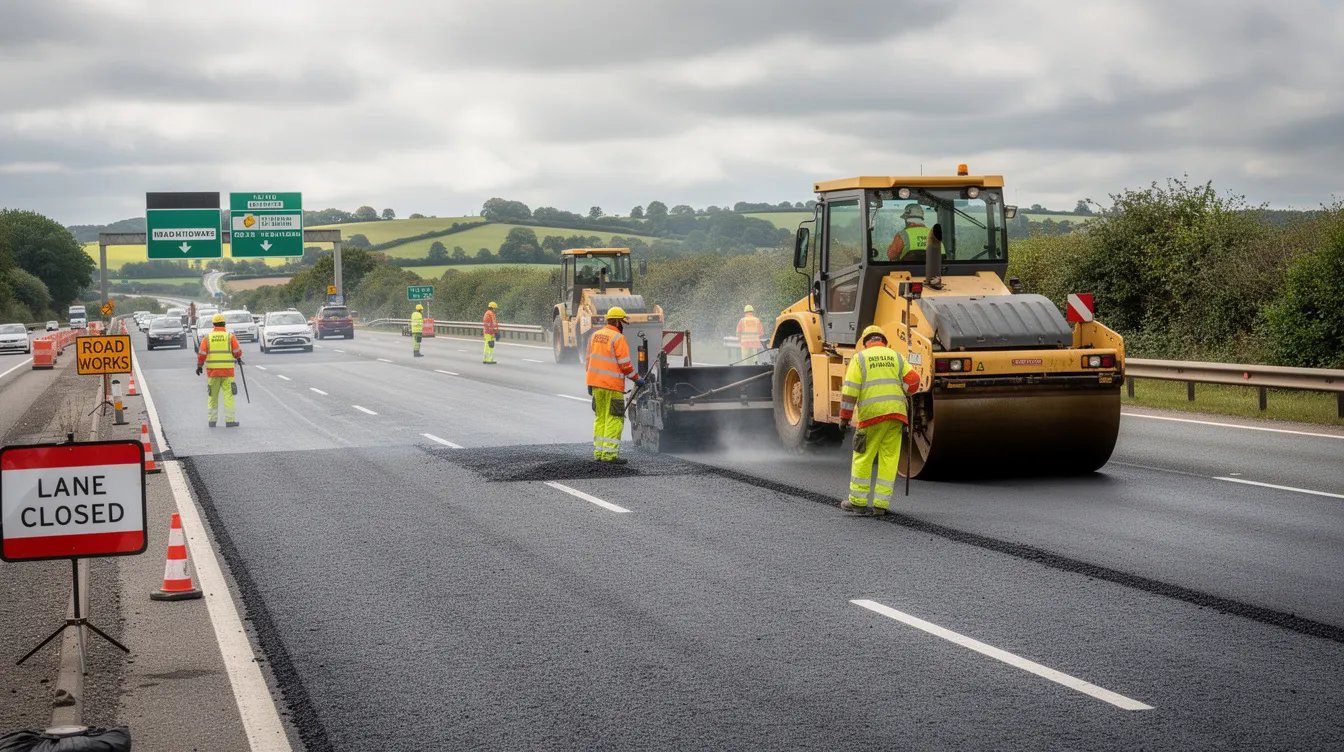
Cold-lay and cold-mix asphalt are useful for potholes, utility reinstatement and fast repairs in commercial yards. The process avoids burner fuel, cuts plant mobilisation and can reopen a site at speed, but it is not a full substitute for premium asphalt on high traffic carriageways. Bio-based binders, lower-carbon bitumen substitutes and electrified plants are also advancing; EAPA is a useful technical source.
Surface Dressing, Micro Asphalt and Other Thin Treatments
Preventative maintenance is often the lowest-carbon option. Surface dressing sprays a bitumen emulsion, applies stone chippings, then rolls and sweeps the road. Surface dressing can extend pavement life by 10-15 years, restores skid resistance, creates a seal against water ingress, and uses far less material than a full overlay.
Micro asphalt uses polymer-modified emulsion, fine aggregate and fillers at roughly 10–20mm. Micro-asphalt improves surface texture and prolongs road life. Micro-Asphalt improves surface texture and prolongs road life while improving appearance on estate roads. Residents may see temporary signs, advisory speed limits, loose chippings and short access restrictions.
Sealcoating helps keep water out of asphalt pavement. Slurry seals, ultra-thin asphalt concrete and high-friction surfacing also extend life when the structure below is sound.
Durability and Lifecycle Cost: Why Cheaper Tarmac Often Costs More
Buying only on price per tonne is a trap. Tarmac is generally one of the most budget-friendly paving options, and tarmac offers exceptional cost-efficiency compared to premium materials, but a low-spec thin surface on a retail park can fail quickly if HGVs turn on it all day. A better-designed SMA or asphalt concrete pavement may cost more upfront but last 20–25 years with fewer closures.
Failures come from rutting, ravelling, cracking, fatigue cracking, potholes, weak soils, poor drainage, inadequate layer thickness and poor rolling. Proper compaction can reduce pavement life loss by 30-40%. Tarmac can withstand significant weight and temperature changes, tarmac forms a non-porous structure that stands up against severe weather, and tarmac performs well in harsh weather conditions when the ground is excavated and compacted before laying tarmac.
Tarmac provides a smoother seamless surface compared to block paving, tarmac is a continuous surface that requires low maintenance, and tarmac does not shift or rut over time like gravel surfaces. Tarmac provides excellent tire grip and traction reducing skidding hazards, produces lower road-noise levels compared to jointed materials, and is tough and less likely to crack under pressure. For lifecycle design, use DMRB and highway standards.
Best Practice Specification for Low‑Carbon Highways (Section 38) and Commercial Hardstanding
Adoptable highways under Section 38 or Section 278 need local authority approval and compliance with Series 900. Bring designers, contractors and asphalt suppliers in early so warm mix asphalt, higher RAP, low-carbon binders and skid-resistant surface choices are approved before procurement locks out innovation.
Commercial hardstanding is different. Distribution yards, loading bays and industrial estates face slow-turning vehicles, heavy point loads and excess stress. Use thicker base and binder courses, polymer-modified binder in critical zones, robust drainage, and premium surface courses where HGV wheel paths punish the pavement. Low carbon asphalt UK choices work best when lower-risk sub-layers carry more recycled content and the top layer is selected for duty.
Tender documents should ask asphalt suppliers for embodied carbon per m², recycled content, performance test data, temperature limits, joint treatment, quality records and options appraisal across construction projects.
Installation Quality, On‑Site Practices and Carbon
Even the best sustainable road surfacing fails if installed badly. Check sub-grade, improve soft soils, compact the sub-base, control moisture, maintain correct thickness, and verify the new surface with density records, delivery tickets and temperature logs. A standard domestic tarmac driveway can be finished in a day, and small sections of tarmac can be patched easily when repairs are needed, but commercial paving still needs disciplined site control.
Warm mix helps in cool UK weather because asphalt stays workable for longer, reducing cold joints and early cracking. Cut carbon by planning deliveries, reducing rejected loads, segregating planings for RAP, limiting haulage and maintaining plant. Lower fumes and lower surface temperature also make works more acceptable near homes, schools and hospitals.
Choosing Durable Tarmac for Commercial Use: Practical Buying Checklist
Ask potential contractors:
- What asphalt concrete mix is proposed for each layer, and why is it suitable for the traffic, drainage and expected life?
- What experience do they have with warm mix asphalt, low-carbon surfacing and durable tarmac for commercial use?
- What RAP, crumb rubber or secondary aggregate content is included, and how are properties proven?
- How will the surface be hand lay finished at edges, compacted, jointed and protected from rain?
- What maintenance plan is assumed? Tarmac requires minimal long-term maintenance compared to alternatives, and tarmac surfaces only require a sweep and protective sealant every 2 to 4 years.
- What whole-life cost and carbon figure is being compared, not just the first invoice?
Policy, Standards and Where to Learn More
Low-carbon Tarmac & Asphalt Surfacing sits inside a fast-moving UK standards world. Read the Net Zero Strategy, National Highways plan, DMRB, ADEPT, CIHT and ICE guidance. Local authorities increasingly ask for carbon reporting, and commercial clients should expect the same disclosure from surfacing partners.
Conclusion: Building Long‑Life, Low‑Carbon Roads and Hardstanding
The practical route is not mysterious: warm mix asphalt, recycled content, surface dressing, micro asphalt, good drainage and proper installation. Cheap, short-life surfacing is rarely the lowest-carbon option once maintenance, traffic disruption and business interruption are counted. Treat asphalt as a strategic asset, not a disposable surface, and UK roads, driveways and commercial yards can be robust, smooth and genuinely lower carbon.