Urban stormwater management is moving beyond the old either-or debate between bigger pipes and greener landscapes. For engineers, contractors and local authorities, the more practical question is how to combine conventional drainage assets with nature-based measures in a way that is measurable, maintainable and resilient under real operating conditions. Recent EPA guidance reflects this shift clearly: improving stormwater resilience increasingly means using both “gray” infrastructure and green infrastructure that mimics nature and captures rainfall where it falls.
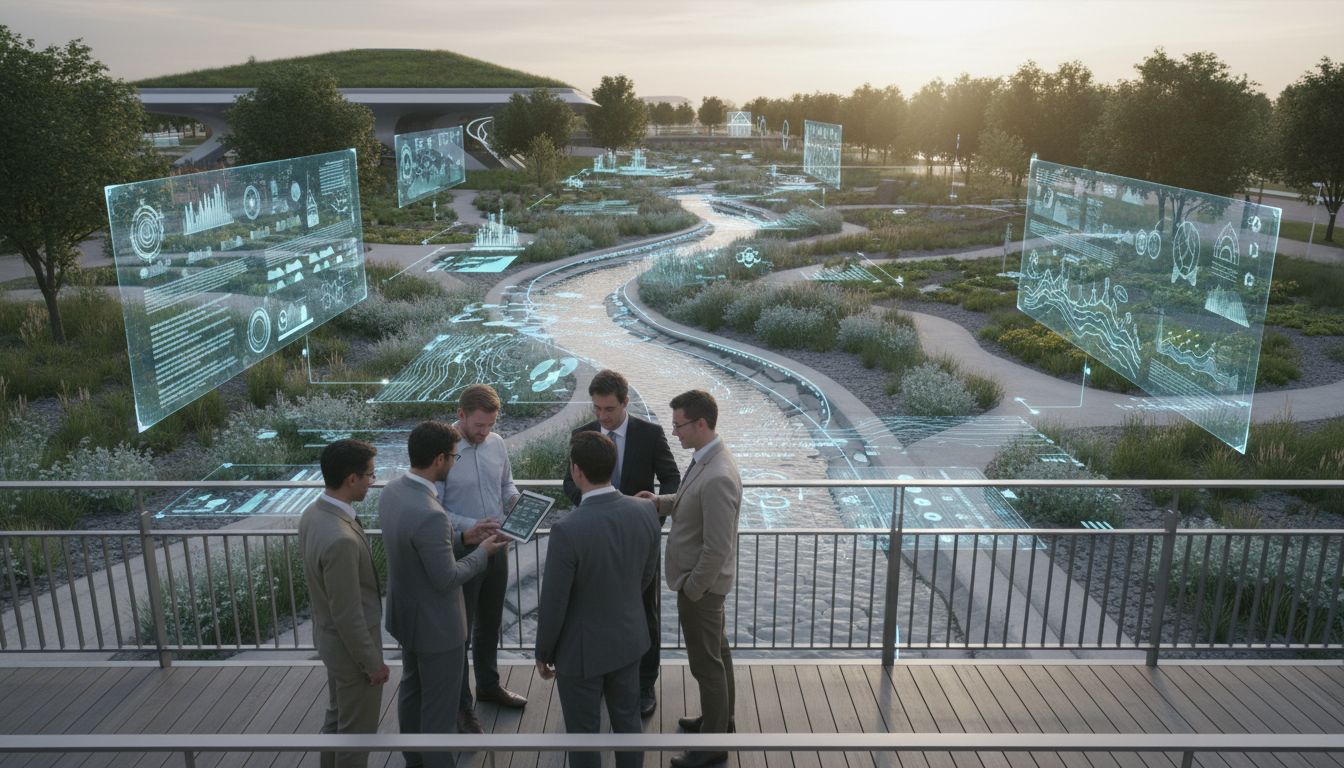
At the same time, digital twin technology is changing how these systems can be planned and run. Instead of relying only on static design assumptions, a stormwater digital twin can connect hydrologic and hydraulic models with rainfall forecasts, site sensors, asset data and operational rules. When that capability is applied to nature-based solutions such as swales, rain gardens, detention landscapes, permeable paving and restored channels, the result is a more adaptive approach to urban flood management,one that suits the growing UK emphasis on whole-life performance, climate resilience and place-sensitive design.
Why stormwater resilience now demands a hybrid approach
Stormwater resilience has become a live issue because urban catchments are under pressure from intensifying rainfall, constrained networks, aging assets and growing expectations around water quality and public realm value. Traditional drainage systems remain essential for conveyance, storage and network control, but on their own they may struggle to deal efficiently with repeated smaller storms, localised surface water flooding and runoff quality issues.
EPA’s current framing is useful here because it avoids false choices. Its position is that stormwater management works best when traditional drainage is optimised alongside green infrastructure. In practical terms, that means using engineered networks for dependable system performance while also deploying measures that slow, store and filter runoff at or near source. For UK practitioners, this aligns closely with SuDS thinking, especially where attenuation, treatment and amenity need to be delivered together.
EPA also highlights that green infrastructure can reduce localised flooding, capture stormwater and improve water quality. Those benefits are particularly relevant in dense urban areas where runoff reaches the drainage system quickly and where public space has to perform multiple functions. The key point is not that nature-based solutions replace conventional assets, but that they can reduce pressure on them while creating a wider resilience dividend.
What a stormwater digital twin actually does
A digital twin is often described loosely, but in stormwater terms it has a fairly practical meaning. It is a dynamic digital representation of a real drainage catchment or water system, linked to current data and used to test, monitor or support operational decisions. A recent 2024/2025 study described a stormwater digital twin built around a physically based hydrologic-hydraulic model connected to rainfall forecasts, real-time gauges and online data assimilation.
That matters because stormwater systems do not operate under perfect certainty. Rainfall is spatially variable, sensors drift, roughness changes over time, and assets do not always perform exactly as designed. The same study focused on urban flood hazard detection under uncertainty, which is highly relevant to actual drainage operations. For practitioners, this means a digital twin is not just a visual dashboard; it is an evolving decision-support tool that improves as more site data becomes available.
The public-health dimension also deserves attention. The study noted that when runoff overwhelms sewer pipes, combined sewer overflows can release pathogens. In other words, stormwater resilience is not only about preventing nuisance flooding or protecting pavements and basements. It is also linked to sanitation risk, environmental compliance and the wider reliability of urban infrastructure networks.
Why nature-based solutions benefit from digital-twin thinking
Nature-based solutions are often promoted for their environmental value, but their practical adoption depends on whether they can be modelled, compared and maintained with confidence. A 2025 open-access study using SWMM in Cali, Colombia evaluated combinations of large- and small-scale nature-based solutions across an urban drainage system. Importantly, it did not assess options only on hydrologic performance; it also included stakeholder-defined criteria.
That is a useful lesson for civil engineering teams. Nature-based solutions need to work not only as ecological features but as operational assets within a managed urban system. The 2025 study explicitly framed urban flooding as requiring solutions that balance hydrologic effectiveness with governance feasibility. In UK terms, that may include adoption routes, maintenance responsibilities, land take, highways constraints, utility conflicts and local authority acceptance.
This is where digital twins become particularly valuable. They can help determine where nature-based solutions should go, how much benefit they add under different storm events, and what trade-offs they create elsewhere in the network. Rather than asking only whether rain gardens, permeable paving or vegetated basins are beneficial in principle, a digital twin supports scenario testing to identify the best locations, scales and combinations for a specific catchment.
From static design storms to adaptive, data-driven control
The broader direction of travel in stormwater management is clear: away from purely static design and toward continuous monitoring, simulation and adjustment. This does not eliminate the need for robust design standards, but it does change how resilience is understood. A system can no longer be judged solely by how it performs against a fixed design event on paper; it must also be judged by how well it responds to changing conditions over time.
Digital twins support that shift by combining live and forecast data with predictive modelling. If rainfall intensity, antecedent moisture or downstream capacity changes, operators can see how the catchment is likely to respond and where intervention may be needed. For detention controls, pumping strategies, smart outfalls or temporary storage activation, this kind of foresight can be operationally significant. It turns resilience from a one-off design output into an active management process.
When nature-based solutions are part of the network, the value of adaptive management increases further. Vegetated systems do not behave as fixed concrete structures do. Their infiltration capacity, biomass, seasonal growth and maintenance condition all influence performance. A digital twin provides a framework to track those effects over time and to update assumptions instead of carrying static values forward indefinitely.
Vegetation, roughness and the limits of static assumptions
One of the strongest technical arguments for linking digital twins with nature-based stormwater design comes from recent work on vegetation dynamics. A 2026 Scientific Reports paper used UAV sensing, AI segmentation and dynamic roughness parameterisation to analyse river-reach behaviour under climate extremes. Its findings are highly relevant to any drainage professional working with restored channels, vegetated swales, floodable corridors or blue-green infrastructure.
The study reported that static models can seriously underestimate vegetation-driven roughness, with growing-season flow resistance underestimated by up to 64%. That has major implications for hydraulic design, flood routing and maintenance planning. If roughness is treated as a fixed value when it is actually changing materially with vegetation condition, there is a risk of misjudging conveyance, freeboard, storage behaviour and overtopping thresholds.
At the same time, the study found that nature-based intervention could improve a stability proxy by around 20% with only about 1% conveyance loss. That is an important reminder that hydraulic efficiency is not the only objective. In some cases, a modest reduction in conveyance can be acceptable if it delivers significantly better ecological stability and potentially more robust long-term channel performance. Digital twins help quantify those trade-offs rather than leaving them as qualitative assumptions.
Planning, policy and the growing resilience agenda
Policy direction is increasingly supportive of this integrated approach. EPA’s stormwater planning guidance emphasises long-term resilience and wider community benefits, noting that better stormwater planning can help communities invest in reliable infrastructure, revitalise waterways and create more green space. Although these sources are U.S.-based, the themes are readily recognisable to UK professionals dealing with climate adaptation, urban quality and multi-benefit infrastructure.
Recent EPA materials also link nature-based approaches with hazard mitigation planning. Pilot regions including Ashland, Oregon, Albany, New York, and Massachusetts have integrated watershed planning, green infrastructure and source-water protection into FEMA hazard mitigation plans. The significance here is that stormwater is being treated not as an isolated drainage issue, but as part of wider resilience governance. That is a useful model for joined-up thinking across planning, highways, utilities and environmental management.
The policy momentum is current rather than historic. EPA updated its presentation “Using Green Infrastructure to Address Stormwater Regulations and Build Resiliency” on 21 July 2026, and its 2035 Green Infrastructure Strategic Agenda explicitly connects nature-based stormwater management with localised flood mitigation, climate resilience and urban space restoration. For practitioners, that underlines a wider market trend: clients increasingly want evidence that schemes deliver technical performance alongside environmental and social value.
What this means for design, construction and maintenance teams
For consultants and design engineers, the practical implication is that drainage models should increasingly be set up to compare hybrid options rather than only conventional upgrades. That means testing how source control, permeable surfaces, detention landscapes and vegetated corridors interact with pipes, manholes, culverts and storage tanks across a full catchment. It also means presenting outputs in a way that supports stakeholder decisions, not just hydraulic compliance checks.
For contractors and groundworks specialists, the shift matters because buildability and maintainability are central to whether nature-based solutions succeed. A bioswale that cannot be accessed for sediment management, a permeable pavement built on poorly understood subgrade conditions, or a detention feature with unclear ownership can quickly lose performance. Digital-twin-informed planning can improve this by identifying where interventions are most worthwhile and by clarifying likely operational needs before construction starts.
For asset owners and maintenance teams, data is becoming as important as physical installation. EPA’s 2025/2026 research agenda highlights modelling, costs, benefits and operation and maintenance issues as part of green/gray infrastructure research. In practice, that suggests a more mature lifecycle view: not simply installing NBS features for planning gain or policy compliance, but tracking how they perform, what they cost to maintain and when interventions are needed to preserve resilience value.
Tools and implementation pathways for real projects
Implementation does not begin with a perfect city-scale digital twin. In many cases, it starts with better use of existing drainage models, rainfall data, CCTV records, telemetry, GIS layers and maintenance logs. The next step is to improve integration between those datasets so that the system can be updated more frequently and used for scenario testing. Over time, that can evolve into a true digital twin with live sensor feeds, forecast inputs and decision support.
Planning tools can also strengthen site selection and business cases. EPA now highlights resources such as EnviroAtlas and the Regional Resilience Toolkit for natural-disaster and geospatial planning support. The exact platforms may differ in the UK market, but the principle is transferable: mapping social, hydrologic, environmental and infrastructure data together helps teams identify where blue-green interventions are likely to produce the strongest resilience return.
A sensible delivery pathway is to start with pressure points. These may include repeatedly flooded junctions, overloaded combined areas, constrained outfalls, development corridors or urban spaces already due for public realm renewal. In such locations, a digital-twin-led appraisal can compare options such as upsized drainage, offline storage, permeable paving, tree pits, rain gardens, filter strips or restored channels. The goal is not to force a green solution everywhere, but to allocate the right intervention to the right problem with evidence behind it.
Digital twins and nature-based solutions are best understood as complementary parts of a modern stormwater strategy. One provides the intelligence layer: continuous data, forecasting, uncertainty handling and scenario testing. The other provides distributed physical function: slowing, storing, filtering and sometimes reusing stormwater in ways that also improve urban space. Together, they offer a route away from reactive drainage expansion and toward a more adaptive model of urban water resilience.
For UK civil engineers, contractors and supply-chain specialists, the opportunity is practical rather than theoretical. Hybrid green-gray design is increasingly backed by policy, while recent research shows that digital twins can improve flood warning, quantify uncertainty, capture vegetation effects and support better placement of nature-based interventions. The most resilient stormwater systems are unlikely to come from pipes alone or planting alone, but from data-led integration of both.