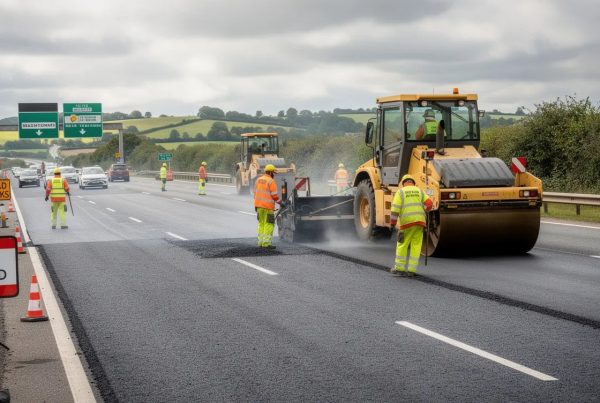
Across the UK, intense rainfall is becoming a more serious design and maintenance issue for sites of every type, from housing developments and public realm schemes to industrial yards, roads, and commercial estates. The adaptation question is no longer whether drainage standards matter, but how to make sites cope better with short-duration, high-intensity storms without simply defaulting to larger pipes, deeper tanks, and more carbon-intensive construction. For civil engineers and groundworks teams, that points toward solutions that retain, slow, infiltrate, and store water closer to where it falls.
That approach aligns strongly with low-carbon and nature-based design. The US EPA defines green infrastructure as a way to mimic nature and capture rainwater where it falls, using measures such as permeable pavement, rain gardens, bioswales, vegetative swales, infiltration trenches, green roofs, rainwater harvesting, downspout disconnection, and urban tree canopies. Importantly, the EPA also notes that as precipitation events become more intense, these measures become more crucial rather than less, because they help reduce localised flooding by absorbing and managing runoff on-site.
Why intense rainfall now demands a different site strategy
Site adaptation starts with recognising that rainfall patterns are changing in ways that can overwhelm conventional layouts. The European Commission has highlighted that storms can now drop up to 40% more rainfall than they would without climate change. In practical terms, that means more surcharge risk, more ponding on hardstandings, more pressure on attenuation systems, and more disruption to access, operations, and asset life.
For UK practitioners, the design implication is straightforward: historic assumptions alone are not enough. Existing drainage infrastructure may still play a central role, but adaptation increasingly requires a broader toolkit that can deal with flashier inflows and reduce runoff before it reaches the pipe network. This is where source control, infiltration opportunities, and landscape-led storage move from being desirable extras to core resilience measures.
The IPCC has also stressed that effective adaptation often works with natural processes rather than against them. In a construction setting, that means shaping levels, surfaces, soils, planting, and open space so that the site can temporarily hold, filter, and release water more safely. It also means accepting that the most robust answer is often not a single asset, but a linked treatment train combining hard engineering with natural water management functions.
What low-carbon and nature-based adaptation means in practice
Nature-based solutions are often discussed at a strategic policy level, but they are highly relevant at project scale. The European Commission describes them as cost-effective, locally adapted, and resource-efficient interventions that provide environmental, social, and economic benefits while building resilience. For site teams, that translates into practical measures that reduce runoff, improve water quality, support biodiversity, and often lower material intensity compared with heavily engineered alternatives.
Low-carbon site adaptation is not only about operational performance during storms. It is also about embodied carbon and long-term landscape value. A scheme that uses permeable surfacing, vegetated conveyance, infiltration features, tree planting, and shallow storage areas may reduce excavation volumes, concrete demand, and reliance on large below-ground structures in some contexts. Even where hybrid systems are needed, the greener elements can still reduce the size and loading of grey infrastructure.
There is also a broader climate case. The IPCC notes that ecosystems such as marshes, mangroves, and seagrasses can sequester carbon at high rates and act as long-term carbon sinks. While those specific habitats are not standard features on most UK development sites, the principle matters: restoring and creating functioning natural systems can provide a genuine low-carbon co-benefit alongside water management. In urban settings, UNEP similarly emphasises that nature-based adaptation can deliver flood control, cooling, and water-quality improvements together.
Rain-at-source measures for paved and developed sites
One of the most useful ways to frame adaptation is rain-at-source management. The EPA explicitly describes green infrastructure in those terms, capturing rainfall where it lands instead of moving it off-site as quickly as possible. On developed plots, that usually starts with the surface itself. Permeable pavement is a practical example, allowing rainfall to pass through the surface into a gravel layer below and then infiltrate into native soil at more natural rates where ground conditions allow.
For contractors and paving specialists, permeable systems can be especially valuable on car parks, footways, low-speed access roads, courtyards, and some service areas. They can cut runoff volumes, reduce peak flow rates, and support water-quality treatment within the sub-base profile. They also fit neatly into phased site design, provided the sequence protects the pavement from sediment clogging during construction and includes clear maintenance responsibilities after handover.
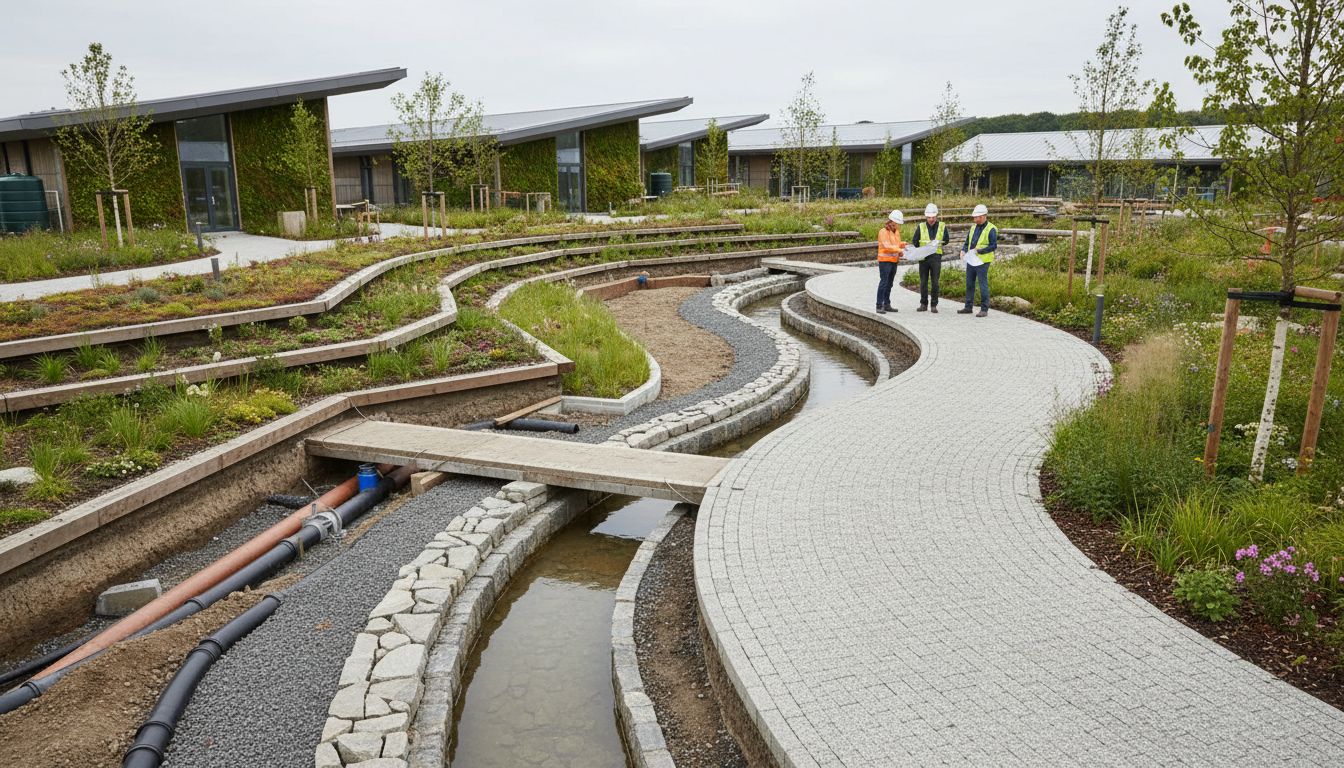
Other source-control measures listed by the EPA include rain gardens, bioswales, vegetative swales, infiltration trenches, rainwater harvesting, green roofs, urban tree canopies, and downspout disconnection. These are not niche add-ons. Used together, they form a distributed drainage network that stores, filters, and slows water before it reaches conventional drainage assets. The EPA’s SWMM stormwater model also includes practices such as bioretention cells, bioswales, permeable pavement, rain barrels or cisterns, rain gardens, and lawns as storage and infiltration tools, which reinforces their role in mainstream drainage design rather than optional landscaping.
Making space for water with wetlands, floodplains, and storage landscapes
Not every site can rely mainly on infiltration, especially where geology, contamination constraints, groundwater levels, or asset sensitivity limit what is possible. In those cases, making space for water is often the more resilient move. UNEP highlights reconnecting rivers to floodplains and rewetting or constructing wetlands as nature-based solutions that help absorb water during intense rainfall or flooding while also contributing to water purification.
For larger developments and infrastructure corridors, that principle can be adapted into site-scale storage landscapes. Shallow detention zones, constructed wetlands, wet basins, linear swales, and blue-green corridors can create managed exceedance routes and temporary storage areas that are easier to inspect and often more multifunctional than fully buried systems. They can support habitat, visual amenity, and urban cooling while also helping to protect downstream receptors.
The wider evidence base is encouraging. The World Bank reports that a retention basin in Buenos Aires reduced flood risk for more than 3 million people, while a restored urban wetland in Colombo protected 280 wildlife species and acted as a carbon sponge. Those are large-scale examples, but the lesson carries across to UK projects: well-designed landscape water storage can deliver flood attenuation, ecological value, and low-carbon co-benefits at the same time.
Why hybrid green-gray systems are often the best answer
In practice, most sites should not be framed as a choice between natural features and engineered drainage. The stronger approach is usually hybrid. EPA research published in 2025 continues to prioritise green and gray infrastructure working together, with attention to costs, benefits, and maintenance. That is a useful message for project teams dealing with tight footprints, difficult ground, and strict performance expectations.
A hybrid design might use permeable paving and bioretention to reduce and treat runoff at source, swales and tree pits to provide conveyance and interception, and then tanks, oversized pipes, or flow controls to manage residual volumes and protect against exceedance. This layered arrangement can improve resilience because no single component has to do all the work. It also gives designers more options when infiltration is partial, not total, or when climate allowances push conventional storage volumes upward.
For UK delivery teams, hybrid thinking also helps with buildability and adoption. Some stakeholders remain more comfortable when a familiar engineered backbone remains in place. Adding nature-based elements around that backbone can still materially improve runoff performance, reduce local flood issues, and create a more adaptable site. The goal is not to replace proven drainage engineering, but to enhance it by using landform, vegetation, and surface design more intelligently.
Cost, finance, and the real barrier to scaling
There is now strong policy support for nature-based adaptation, yet funding still lags badly behind the level required. UNEP’s State of Finance for Nature 2026 says investment in nature-based solutions needs to rise to US$571 billion annually by 2030 to meet biodiversity, climate, and land-restoration targets. It also notes that US$7.3 trillion flowed into nature-negative activities in 2023. In other words, the strategic case is increasingly clear, but capital allocation remains out of step with resilience needs.
The urban picture is similar. UNEP’s State of Finance for Nature in Cities 2024 says financing for urban nature-based solutions needs to increase from US$200 billion to US$542 billion by 2030. For construction professionals, this matters because many of the techniques needed on sites are proven and available now, but budgets, procurement models, and appraisal methods do not always capture their long-term value. Flood reduction, heat mitigation, water-quality gains, and biodiversity benefits are often spread across different teams and funding lines.
That said, there is growing momentum. The European Union’s Mission on Adaptation has reported work with more than 400 regional and local authorities and over 200 demonstration sites piloting scalable resilience solutions. The World Bank has also backed substantial portfolios, reporting US$12 billion in financing for nature-based and green-gray activities from 2012 to 2024. These signals matter because they show that implementation is moving beyond theory, even if the global finance gap remains very large.
Design considerations for UK civil engineers and groundworks teams
For site designers in the UK, adapting to intense rainfall with low-carbon and nature-based measures starts with an honest reading of local constraints. Soil permeability, groundwater, contamination risks, utility conflicts, winter maintenance needs, access loading, and maintenance capability all affect what can realistically be delivered. A permeable paving system may be ideal in one zone of a site and unsuitable in another. Likewise, a rain garden that performs well in a public frontage may not suit a service yard with heavy trafficking and pollution risk.
Early coordination is therefore essential. Drainage engineers, highways teams, landscape designers, earthworks specialists, and maintenance stakeholders should be involved before levels and plot ratios are fixed. Too often, blue-green features are squeezed in late, after the site has already been value-engineered around hard boundaries and maximum hardstanding. When considered early, however, they can shape the layout, reduce runoff pathways, support exceedance planning, and create more forgiving construction tolerances.
It is also worth designing for inspection and upkeep from day one. Nature-based features are not maintenance-free, and they should never be sold that way. Sediment management, vegetation establishment, inlet protection, debris removal, and periodic performance checks all matter. The best systems are the ones that site teams can understand, access, and maintain without specialist intervention every time there is a storm event. That practical mindset is what turns a good concept into dependable site infrastructure.
The evidence base is improving, and so is the implementation case
One reason nature-based adaptation is becoming harder to ignore is that the evidence base is growing across different climates and project scales. In February 2025, the World Bank and WRI launched a major assessment of nearly 300 projects in Sub-Saharan Africa to identify what works in scaling nature-based solutions for flooding, drought, and heat resilience. That matters because it moves the conversation from isolated case studies toward clearer implementation lessons.
At the same time, international guidance is becoming more explicit about climate-adjusted hydrology. The World Bank’s flood-protection guidance emphasises that understanding how precipitation is changing over time is essential when designing nature-based flood solutions. This is highly relevant to UK practice, where drainage design must increasingly deal with uncertainty, changing storm profiles, and the need for adaptable systems rather than static assumptions.
The IPCC also notes that barriers remain, including limited finance and low uptake of adaptation science. For the construction sector, that suggests a clear opportunity: take the available evidence, apply it in practical site design, and bridge the gap between policy ambition and delivered assets. The firms that get comfortable with these methods now will be better placed to deliver resilient, compliant, and lower-carbon schemes as client expectations continue to rise.
Adapting sites for intense rainfall is ultimately about more than drainage compliance. It is about creating places and assets that can absorb shocks, recover quickly, and continue to perform under more volatile weather conditions. Nature-based and low-carbon approaches offer a practical route to that outcome by slowing water down, keeping more of it on-site, and making better use of soils, surfaces, planting, and landscape form.
For UK civil engineering and groundworks professionals, the most effective path is rarely ideological. It is practical, evidence-led, and hybrid where needed. Use conventional infrastructure where it adds reliability, but pair it with permeable pavements, swales, rain gardens, wetlands, storage landscapes, and other rain-at-source measures wherever site conditions allow. As intense rainfall becomes a more common design driver, working with nature is not a soft option. It is increasingly the smart engineering option.