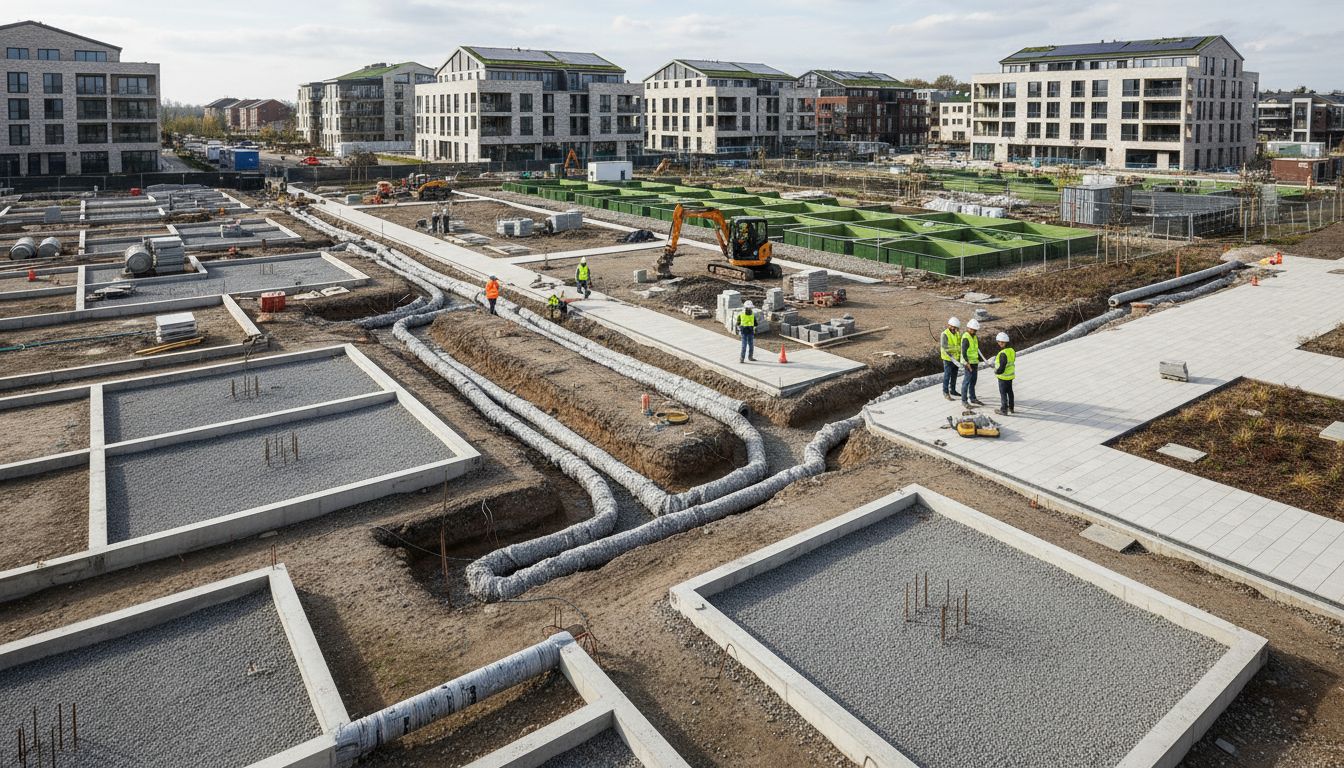
Preparing sites for net-zero is no longer just a question of reducing operational energy later in a project. For civil engineers in the UK, groundworks teams, and drainage designers, the carbon profile of a scheme is heavily influenced by what happens below ground and across the site surface from day one. Substructures, drainage layouts, material choices, levels design, and water-management strategy all lock in long-term environmental performance, maintenance demand, and resilience outcomes.
That is why low-carbon substructures and sustainable urban water management need to be planned together rather than treated as separate workstreams. Recent research and policy increasingly point in the same direction: cities can move towards net-zero only when embodied carbon is reduced alongside better urban water resilience, using measures such as permeable surfaces, nature-based systems, and smarter drainage infrastructure that works with natural hydrology instead of against it.
Why site preparation now sits at the centre of net-zero delivery
Site preparation has become a strategic part of carbon reduction because it determines a large share of a project’s embodied emissions before the superstructure even begins. Excavation volumes, imported fill, capping layers, concrete content, pipe runs, attenuation structures, and surfacing build-ups all have carbon consequences. Once installed, these choices also influence maintenance cycles, adaptability, and whether future retrofit becomes difficult or carbon-intensive.
Recent planning and policy thinking is reinforcing that point. The 2024 World Cities Report frames water and sanitation infrastructure, water-resource management, and retrofit of water systems as part of resilient low-emission urban development. In parallel, more recent local-plan sustainability appraisals are starting to link site preparation explicitly with carbon reduction, construction minimisation, and sustainable water-resource management. In practical terms, that means the groundworks package is no longer a purely enabling exercise; it is part of the project’s net-zero strategy.
For contractors and designers, the implication is straightforward. Early decisions on formation levels, pavement construction, sub-base type, infiltration feasibility, drainage routing, and material reuse can either support a low-carbon pathway or undermine it. By the time a scheme reaches detailed drainage coordination, many of the biggest opportunities may already have been lost.
Low-carbon substructures: reducing embodied carbon below ground
Low-carbon substructures start with asking whether the design genuinely needs the volume of material, excavation depth, and rigid construction initially assumed. On many sites, carbon savings come from reducing overdesign, reusing suitable excavated material, limiting haulage, and avoiding unnecessary concrete-heavy solutions where geotechnical and performance requirements allow alternatives. This is especially relevant on hardstanding, access roads, external works, and shallow foundation interfaces tied to drainage infrastructure.
Permeable surfaces are increasingly important here because they can perform as both a substructure and a water-management intervention. Recent evidence from the IPCC’s urban pathways work, alongside 2025 and 2026 drainage studies, identifies permeable surfaces as a practical means of reducing runoff, supporting infiltration, and lowering the broader emissions impacts associated with conventional sealed surfaces and oversized downstream drainage. For paving and groundworks specialists, that makes permeable construction more than a SuDS feature; it is a core low-carbon substructure strategy.
Life-cycle assessment is also changing how below-ground options are selected. A 2025 systematic review showed that the most effective green stormwater infrastructure choices are not simply the cheapest or the smallest upfront, but the ones that balance system size, vegetation, and longer asset life to lower normalised environmental and economic impacts over time. In other words, a design that looks cost-efficient at tender stage may still be a poor carbon decision if it delivers limited treatment, short service life, or intensive replacement demands.
Moving beyond grey drainage to green-grey infrastructure
Conventional grey drainage still has a place in urban construction, but on its own it is increasingly viewed as resource-intensive and ecologically limited. Recent literature continues to note that rigid pipework-led drainage and cistern-based approaches can be expensive, disruptive to natural hydrological cycles, and relatively inefficient in delivering wider environmental value. If the only objective is to move water off site quickly, projects may miss far better outcomes on flood resilience, heat mitigation, biodiversity, and carbon.
That is where green-grey infrastructure is gaining traction as a practical delivery model. Instead of replacing engineering discipline with landscape-led concepts, it combines the two: pipes, controls, and timed discharge work alongside swales, permeable pavements, bioretention areas, wetlands, and storage features. Recent research shows that blending nature-based solutions with controlled stormwater discharge can reduce flood risk while also lowering environmental impacts compared with drainage-only approaches.
For UK practitioners, this hybrid model is often the most realistic route. Dense urban sites, adoption requirements, utility constraints, and variable ground conditions rarely allow a purely green solution. But equally, defaulting to entirely sealed and piped systems can create long-term carbon and resilience penalties. Green-grey infrastructure gives project teams room to design for compliance, buildability, and maintenance while still improving net-zero performance.
Using low-impact development to control water at source
Low-impact development, or LID, is now central to sustainable urban water management because it aims to reduce runoff at source rather than relying only on downstream storage or conveyance. Recent studies from 2025 and 2026 highlight the growing use of permeable pavements, bioretention systems, rain gardens, roof gardens, infiltration trenches, and swales to improve infiltration, provide temporary storage, and support groundwater recharge in urban catchments.
The performance case is becoming harder to ignore. A 2025 basin-scale hydrology study reported maximum flood-volume reduction of 38.82% and peak reduction of 37.75% in impervious areas under optimised LID combinations. Those are material outcomes for designers dealing with constrained discharge rates, exceedance management, and local flood-risk requirements. They also support a simple design principle: if runoff is intercepted and slowed close to where it falls, the whole drainage train works less hard.
What matters in practice is that LID is rarely a single product decision. The latest evidence consistently shows that combinations of measures outperform individual interventions. Green roofs, permeable pavements, rain barrels, bioretention zones, and swales each address different parts of the runoff pathway. When combined properly, they provide more robust hydraulic performance and better resilience under changing rainfall patterns than any one element working alone.
Designing for the full urban water cycle, not isolated assets
One of the more important shifts in current SuDS practice is the move away from assessing assets in isolation. The 2025 “rain to drain” SuDS briefing describes monitoring from rainfall through to drainage across wider geographical areas, reflecting a broader view of sustainable drainage as a full urban-water-cycle intervention. That matters because the true performance of a system depends on how upstream surfaces, storage zones, conveyance routes, soil conditions, and discharge controls interact over time.
For site teams, this means drainage design should begin with a catchment mindset rather than a component list. Where does water land first? What can infiltrate? What needs treatment? What can be reused? Where can exceedance go safely? And how will maintenance affect performance in five, ten, or twenty years? These questions tend to produce more resilient layouts than the traditional approach of sizing pipes and tanks after the hard landscaping has already been fixed.
There is also a strong circular-economy angle emerging in the latest research. Urban water management is increasingly being framed around stormwater as a usable resource rather than only a waste stream. Reuse, infiltration, storage, and staged treatment all fit naturally with net-zero thinking because they reduce pressure on potable supplies, avoid unnecessary pumping and conveyance, and restore more natural water behaviour on developed land.
Carbon, cost, and asset life: making better option choices
One of the most useful messages from recent research is that low cost does not automatically mean low carbon. The 2025 systematic review of green stormwater infrastructure found that options with lower economic impact do not necessarily deliver lower environmental impact per unit of water-quality volume treated. That is highly relevant for procurement teams, because schemes can easily be steered toward the cheapest capital line item even where whole-life carbon and performance are weaker.
This is why life-cycle assessment and life-cycle costing are becoming more important in early option appraisal. Rather than comparing assets on simple capital expense, project teams are increasingly using LCA, LCC, GIS, SWMM, and multi-criteria decision-making to evaluate where, how, and at what carbon cost interventions should be deployed. The evidence base is clearly shifting from asking whether SuDS and LID work to asking where they should be placed, how they should be combined, and what long-term carbon burden they create.
Vegetated systems deserve particular attention in these assessments. The same review found that vegetation can improve pollutant removal, while longer lifespans help offset upfront carbon and cost over time. That should encourage a more balanced view of maintenance-led objections. A vegetated asset may require regular management, but if it delivers better treatment, stores carbon, lasts longer, and reduces the need for larger downstream infrastructure, it may still be the better whole-life choice.
Optimising placement and retrofit under climate uncertainty
Placement matters as much as technology choice. A 2025 spatial optimisation framework for climate-adaptive urban LID concluded that location planning under climate uncertainty can guide more sustainable stormwater systems. In plain terms, the same SuDS feature can perform very differently depending on where it sits in the catchment, the surrounding imperviousness, local topography, and how it links to the wider drainage network.
This has direct implications for both new-build and retrofit work. Urban drainage renewal is increasingly recognised as an irreversible structural decision with long-lasting consequences for materials, energy use, and maintenance demand. Research published across 2025 and 2026 stresses that early low-carbon choices are critical because once a site is built out, changing levels, replacing buried infrastructure, or retrofitting infiltration measures becomes far more disruptive and carbon-intensive.
For existing developed sites, that does not mean opportunities are closed off. It means retrofit should be targeted intelligently. Replacing selected impermeable areas with permeable paving, introducing bioretention into verge lines, reworking kerb drainage to feed swales, or using staged treatment trains around refurbishment schemes can all improve resilience without wholesale reconstruction. The best-performing retrofit programmes are usually the ones that identify the most influential parts of the catchment first.
Co-benefits that strengthen the business case
Decentralised stormwater systems are now being valued for much more than runoff control. A 2026 study identified pollutant reduction, carbon sequestration, and heat mitigation as measurable co-benefits, with soil organic carbon in such systems ranging from 26.3 to 80.2 Mg/ha depending on design and location. That is a useful reminder that sustainable urban water management can support multiple project objectives at once, especially on urban sites under pressure to deliver climate adaptation and environmental net gain alongside carbon reduction.
Cooling is another increasingly relevant benefit. A 2026 study on high-density residential areas found that runoff control and urban cooling are often co-benefits of the same interventions, particularly where large areas of impervious surfacing intensify heat-island effects. For designers of streetscapes, podiums, external amenity areas, and estate infrastructure, this creates a stronger argument for vegetated and permeable systems that moderate surface temperature as well as manage rainfall.
Treatment trains can also contribute to carbon goals when aligned properly. A 2025 study reported that a high-rate activated sludge plus three-stage constructed wetland system achieved a carbon-neutrality contribution of 35.4%, illustrating how water treatment and carbon reduction can be integrated rather than treated as competing aims. While not every site will justify wetlands or advanced treatment stages, the principle is important: water infrastructure can be designed to deliver resource and carbon value, not just compliance.
For construction professionals preparing sites for net-zero, the main lesson is clear: the best outcomes come from combining low-carbon substructures with sustainable urban water management from the outset. Permeable surfaces, source-control measures, green-grey drainage, and life-cycle-led material choices are no longer niche extras. They are becoming the practical toolkit for reducing embodied carbon, improving flood resilience, and creating urban infrastructure that performs better over the long term.
In the UK context, that means closer coordination between civil engineering services, geotechnical, drainage, highways, landscape, and delivery teams at the earliest design stages. The question is no longer simply whether SuDS or LID can work. It is where they should go, how they interact with the substructure, and what carbon, maintenance, and resilience outcomes they lock in for decades a. Get those early decisions right, and site preparation becomes a genuine enabler of net-zero development rather than a missed opportunity below ground.