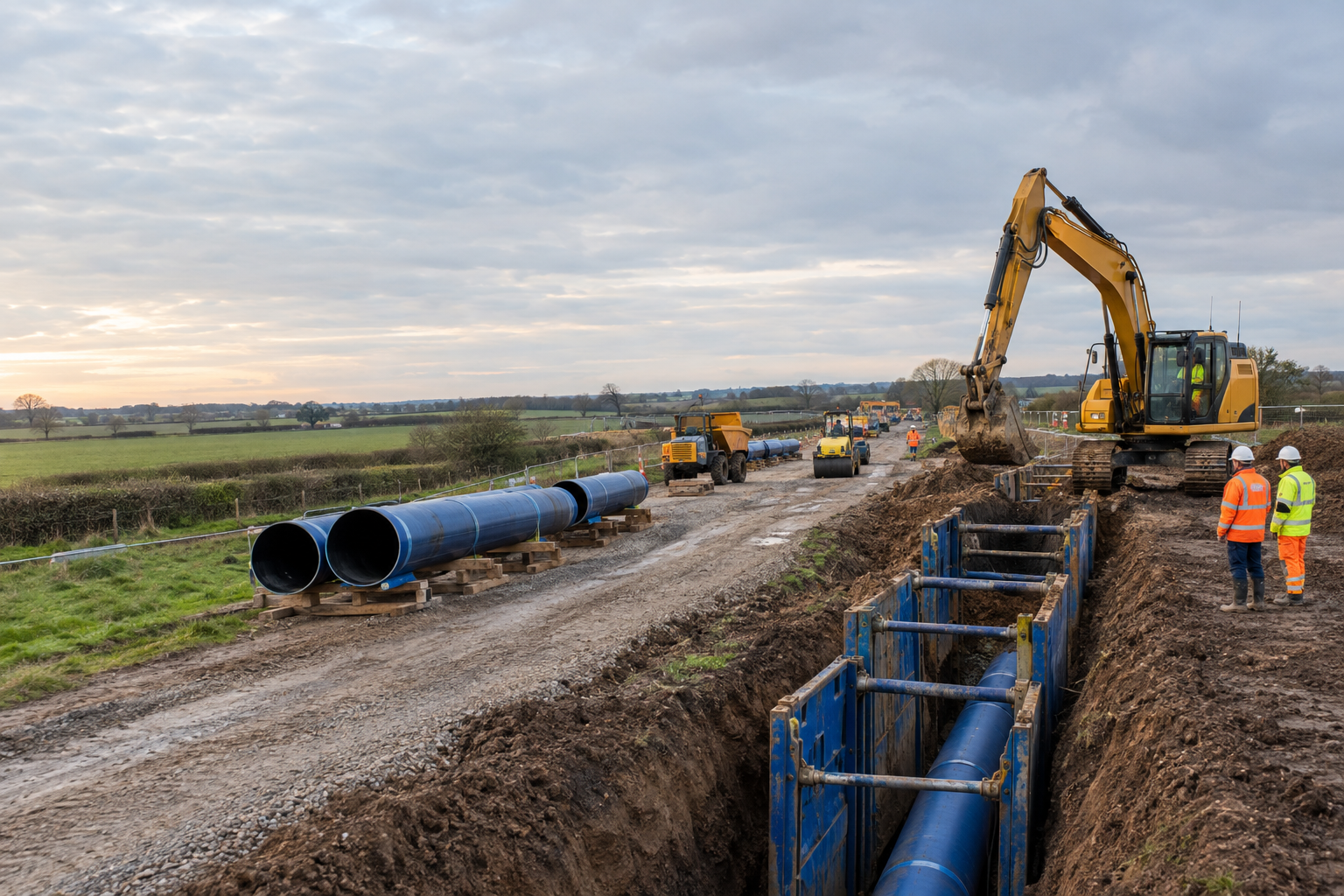
AMP8 water investment is a major story for UK civil engineering, but the headline spending commitments only tell part of it. Across England and Wales, water companies are working through their 2025 to 2030 investment programmes, with implications for treatment works, pipelines, pumping stations, stormwater storage and the contractors needed to build them. I’m watching how those commitments translate into properly scoped, consented and buildable projects.
For groundworks and infrastructure businesses in Lincolnshire, the East Midlands and beyond, the opportunity is substantial. So is the delivery challenge. More investment does not automatically mean a steady flow of construction-ready work, particularly when design capacity, environmental approvals, specialist labour and access to operational assets all need to line up.
What AMP8 actually means for civils workloads
AMP8 is the eighth Asset Management Period, covering April 2025 to March 2030. It is the five-year planning and investment cycle for the regulated water sector in England and Wales. Through its PR24 price review, Ofwat set company-specific allowances and performance expectations that shape what water companies can recover from customers and what they are expected to deliver.
It is worth separating the overall expenditure envelope from the construction opportunity. Water company spending includes operating costs, maintenance, technology and other activities alongside capital projects. Even within capital investment, a treatment upgrade might contain a substantial mechanical and electrical package but a relatively modest groundworks element. A new storage tank or strategic pipeline presents a very different workload.
Where the groundworks demand is likely to sit
The most relevant packages for civils contractors include excavation and temporary works, reinforced concrete structures, pipe installation, access roads, drainage alterations and reinstatement. Storm overflow improvement schemes can require additional storage or changes to sewer networks, while treatment capacity upgrades may involve new foundations, chambers and connections within tightly constrained sites.
Environmental programmes are an important driver, but the regulatory arrangements are not identical across the border. In England, the Environment Agency’s Water Industry National Environment Programme sets out environmental actions for water companies. In Wales, Natural Resources Wales has a corresponding role through the National Environment Programme. Contractors should understand the obligations behind a scheme without assuming that every environmental requirement produces the same construction solution.
The pipeline matters less than its readiness for construction
The first question I would ask about an AMP8 opportunity is not simply its value. It is how far the scheme has progressed through surveys, design, land access, consents and procurement. A project appearing in an investment programme is not the same as an instruction to mobilise, and an appointment to a framework does not necessarily guarantee work.
That distinction matters for contractors deciding whether to recruit, buy plant or reserve specialist subcontractors. Programme announcements can create expectations of an immediate surge, while individual packages remain dependent on technical decisions or third-party approvals. A credible workload forecast needs to distinguish early engagement, tendered work and committed orders.
Watch the interfaces before committing resources
Many water projects involve live assets that cannot simply be switched off. Shutdown windows, temporary bypass arrangements, access restrictions and commissioning sequences can determine the pace of construction as much as excavation productivity. Clear responsibility for these interfaces should be established before a contractor prices the work, not left for the site team to resolve.
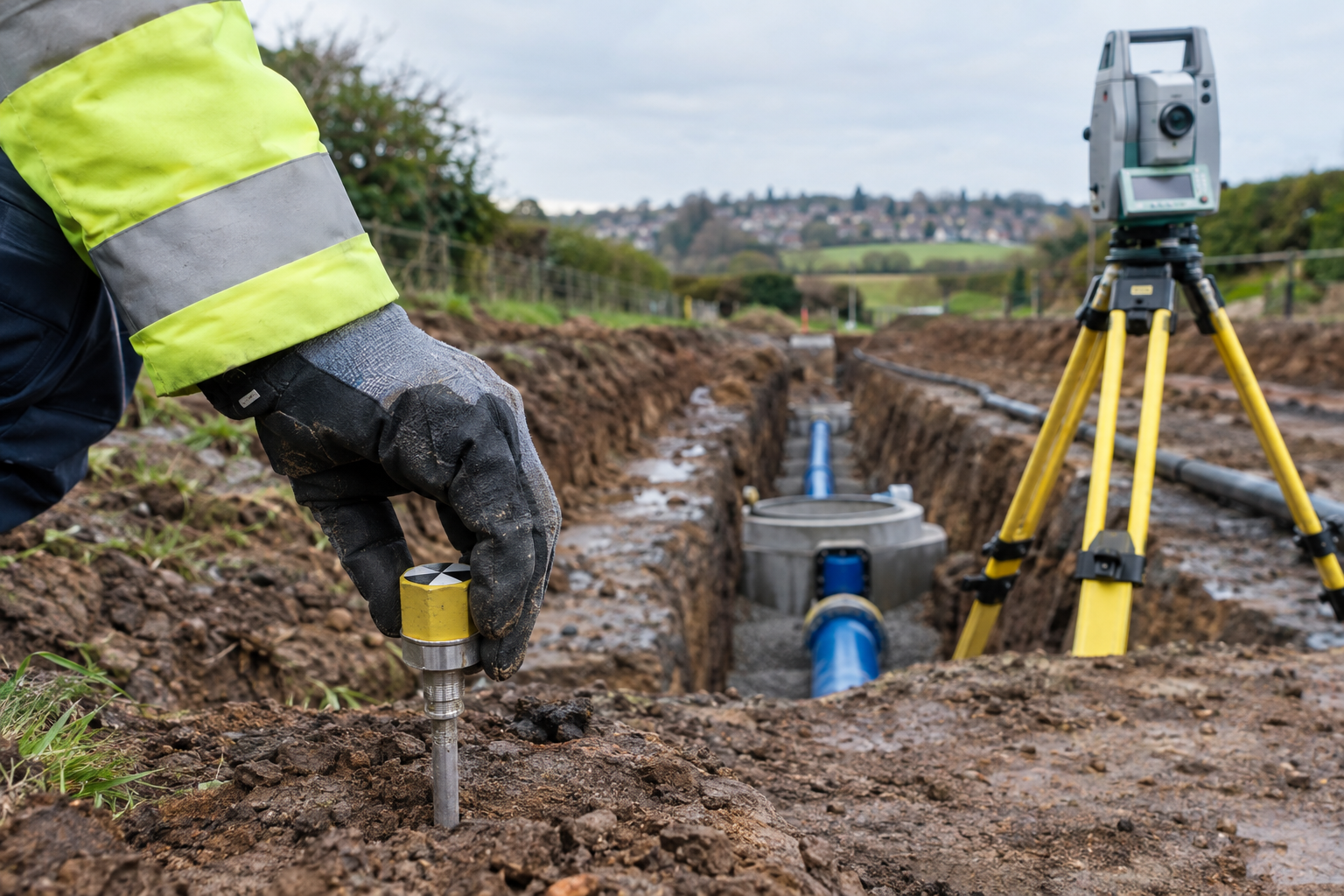
In low-lying parts of Lincolnshire and the wider East Midlands, groundwater, soft ground and nearby drainage infrastructure can also materially affect buildability. Where works interact with watercourses or managed drainage systems, the relevant approval route needs checking early. Depending on the location and activity, this may involve the Environment Agency, a lead local flood authority or an internal drainage board.
For an initial bid review, I would prioritise the quality of ground investigation information, the proposed dewatering approach, utility records and realistic working space. Those details help establish whether the programme and price are achievable. They also reveal whether risk has been properly investigated or simply passed down the supply chain.
Commercial terms will decide whether the opportunity is worthwhile
A busy order book is not much comfort if the work consumes cash and leaves the contractor carrying risks it cannot control. For AMP8 civils packages, I would look closely at how the contract deals with ground conditions, design development, restricted access and changes to the construction sequence. These are not minor qualifications. They can determine whether a package is commercially viable.
Take a pumping station upgrade where the permanent works depend on a temporary bypass being operational. If another supplier is responsible for that bypass, the civils contractor needs a clear basis for planning its start date and recovering the consequences of delay. Simply including an ambitious mobilisation date in the programme does not resolve the dependency.
Check what framework appointments actually provide
Frameworks can offer continuity, repeatable standards and the chance to develop a productive relationship with a delivery partner. However, contractors should distinguish an anticipated programme allocation from an actual commitment. Further competition, performance requirements and changes to a water company’s priorities can all affect the work that eventually reaches site.
Before committing capacity, I would want to understand the call-off process, pricing mechanism, payment terms and any requirements to maintain resources between packages. Where rates are expected to apply over several years, the treatment of labour, fuel, materials and disposal cost changes deserves particular attention. A price that works for one location and construction sequence may not suit a substantially different package.
Under NEC contracts, where used, early warnings and compensation event procedures need active management. Site records should capture access restrictions, instructions, resource deployment and the actual conditions encountered. Good administration is not about manufacturing claims. It is about dealing with change while the evidence is clear and the parties still have options.
Labour and specialist capacity could set the delivery pace
The sector does not just need more excavators and operatives. It needs competent supervisors, temporary works personnel, engineers, experienced pipe layers and teams able to deliver quality concrete structures. Depending on the package, it may also need specialist support for trenchless installation, dewatering, lifting operations and commissioning interfaces.
These resources are shared with highways, energy, housing and other infrastructure programmes. Across the East Midlands, contractors should therefore assess AMP8 opportunities against their wider workload rather than assume that suitable labour and subcontractors will be available when a delayed scheme finally receives approval.

Competence needs to match the asset and the task
Working on a water company site introduces requirements beyond general construction competence. Depending on the asset and scope, these may include water hygiene training, client authorisations, confined space arrangements and specific procedures for working near operational equipment. Requirements should be confirmed with the delivery partner before mobilisation, with sufficient time allowed for training and approval.
A chamber is not automatically safe to enter because it is new or has not yet been connected. Confined space risks depend on the conditions and foreseeable hazards, including restricted access, gases and flooding. Where the Confined Spaces Regulations 1997 apply, the starting point is to avoid entry where reasonably practicable. Where entry is necessary, a safe system of work and suitable emergency arrangements are essential.
I would also watch whether programmes provide enough supervision for multiple small sites. Several dispersed pumping station or sewer improvement packages can stretch management capacity more than one larger project. Travel, inspections, permits and coordination all take time, even when the excavation quantities appear modest.
Environmental improvements still need careful construction controls
A scheme intended to improve river water quality can still cause pollution during construction if the basics are poorly managed. Silty runoff, uncontrolled pumping, fuel handling and concrete washout all need attention. Environmental controls should form part of the construction method and budget, not become an improvised response after water starts entering an excavation.
Dewatering is more than choosing a pump
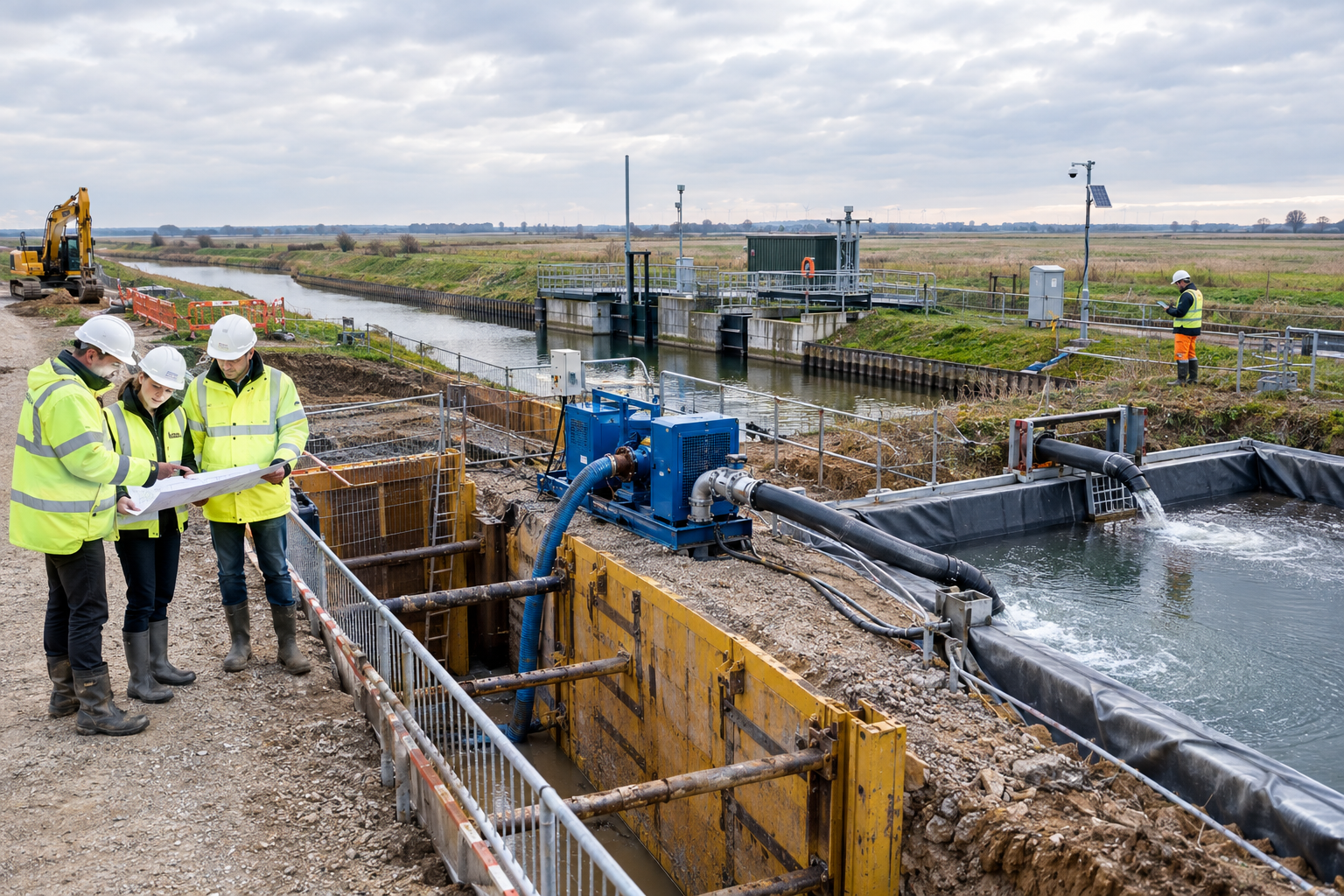
For a deep chamber in groundwater, the important questions include how much water may need removing, how it will be treated, where it can lawfully go and whether pumping could affect nearby structures or habitats. Groundwater control can also influence excavation stability and settlement beyond the working area.
Abstraction and discharge are separate regulatory considerations. The necessary permissions depend on the activity, location, water quality and receiving environment. Contractors should not assume that apparently clear water can be pumped into a ditch, surface water sewer or watercourse without checks. Consent to use land or cross a drainage asset does not, by itself, authorise a discharge.
In Lincolnshire, early discussions with the relevant internal drainage board can be particularly valuable where works affect its district or assets. Those discussions should sit alongside checks with the appropriate environmental regulator and asset owners, rather than being treated as a substitute for them.
Plan excavated material before it leaves the ground
Pipeline and storage schemes can generate substantial quantities of excavated material. Its suitability for reuse, contamination status and legal classification should be investigated early enough to influence the design and logistics. Reuse is not automatically lawful simply because it reduces vehicle movements or avoids disposal costs.
Where material is waste, duty of care obligations and appropriate documentation apply. Where a project proposes a recognised materials management route, the relevant criteria and records need to be in place. Pricing all excavated material as reusable clean soil before the evidence exists is an obvious commercial and compliance risk.
Standardisation could help, provided it respects the site
Repeatable designs offer a practical way to reduce engineering effort and improve delivery consistency across AMP8 programmes. Standard chamber arrangements, reinforcement details and prefabricated components can simplify procurement and inspection. The strongest opportunities are likely to be where a water company has several assets performing similar duties.
However, a standard asset is not the same as a standard excavation. Ground bearing capacity, groundwater, buried services, lifting access and transport restrictions still require site-specific assessment. A precast solution that reduces installation time might need a larger crane, a more substantial working platform or delivery access that a narrow rural lane cannot readily accommodate.
Measure the whole installation, not just time in the excavation
When comparing construction options, I would include temporary works, deliveries, lifting operations, connections and reinstatement alongside the permanent structure. A component that is quick to install may offer little overall programme benefit if its lead time is long or its connections require extensive alterations to existing assets.
Carbon comparisons need a similarly complete view. Concrete specification, reinforcement quantities, haulage, pumping duration and material reuse can all affect the result. Lower-carbon options should be assessed against durability, structural requirements and the water company’s acceptance criteria, rather than selected on a product claim alone.
Quality records need to develop alongside the works
Much of the civils work on water infrastructure becomes difficult or expensive to inspect once it is buried, backfilled or brought into service. That makes inspection and test planning a delivery issue from the outset. Hold points, acceptance criteria and responsibilities should be agreed before the relevant activity starts.
For a pipeline package, records might include bedding inspections, jointing information, surveys and specified testing. Reinforced concrete works may require evidence covering reinforcement, cover, waterstops, concrete supply and curing. The exact requirements depend on the design and asset standards, but the principle is consistent: evidence should be collected when the work is accessible.
Accurate as-built information also matters to the people who will operate the asset. A chamber location, pipe level or valve arrangement recorded incorrectly can create problems long after the construction team has left. I would treat progressive handover documentation as part of production, with named responsibility and regular checks, rather than a paperwork exercise reserved for the final weeks.