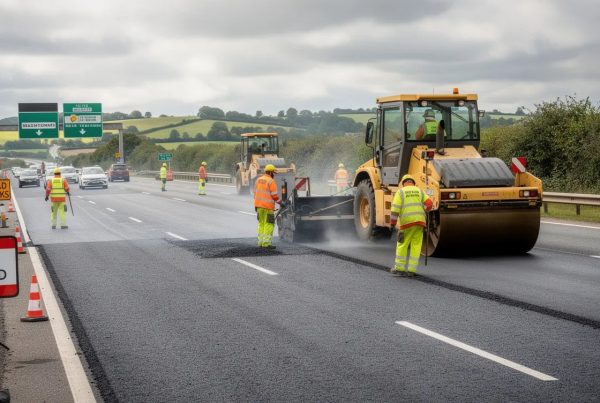
Urban brownfield land is back at the centre of UK development strategy, but getting a site from legacy risk to genuinely build-ready now demands a tighter, more integrated approach. For civil engineers, groundworkers and surfacing specialists, the challenge is no longer just remediation in isolation; it is coordinating contamination control, drainage compliance, material selection and long-term resilience in one workable delivery plan. That shift matters most on dense urban plots, where every design choice affects programme, permitting, runoff performance and future maintenance.
Recent regulatory and technical guidance underlines the same point from different angles: redevelopment works best when assessment, cleanup and stormwater design are planned together from the outset. US EPA brownfields guidance continues to stress that planning supports safe reuse decisions, while newer stormwater rule updates from places such as Portland, Connecticut and New Jersey show how urban infill expectations are tightening around resilience, water quality and climate-era performance. For UK practitioners, the lesson is practical rather than geographic: build-ready status is increasingly about proving that the ground, the drainage strategy and the finished surface all work together under current and future conditions.
Why build-ready now means more than remediation complete
On older urban sites, the phrase build-ready used to suggest that the obvious constraints had been addressed: structures removed, hotspots identified, remediation completed and a platform prepared for construction. In practice, that definition is no longer enough. Developers, regulators and delivery teams increasingly expect evidence that the site can also manage stormwater effectively, tolerate heavier rainfall patterns and avoid creating new environmental pathways once the surface treatment is installed.
That is especially relevant on brownfield plots where legacy contaminants may still be present at depth or managed in situ. EPA guidance on brownfield runoff and reuse consistently frames redevelopment as a process that should balance cleanup, water quality improvement and practical site performance. In other words, remediation is not simply a standalone preconstruction package; it is part of a wider engineering sequence that influences drainage choices, capping design, excavation controls and surfacing specification.
For UK contractors and consultants, this has a familiar feel. A site can look commercially ready on paper, yet still carry unresolved questions about infiltration risk, underdrain requirements, sub-base compatibility or how recycled materials will perform within a constrained drainage envelope. The practical takeaway is straightforward: build-ready should mean ready for safe construction and ready for compliant, resilient operation after handover.
New regulations are tightening expectations on urban infill sites
One of the clearest trends in recent guidance is the movement towards more explicit, updated stormwater requirements for redevelopment sites. Portland’s 2025 Stormwater Management Manual, effective from 1 March 2025, applies to development, redevelopment and improvement projects on both public and private property. The important signal here is not just the detail of one city’s manual, but the wider direction of travel: local rules are being revised to reflect current regulatory requirements and technical standards, and that raises the bar for what qualifies as acceptable urban site design.
Likewise, New Jersey DEP’s REAL rules are positioned as a comprehensive climate-era update to land resource protection regulations. Their stated focus on resilience to sea-level rise, chronic flooding, extreme weather and improved water quality reflects an increasingly common regulatory mindset. Sites are not being assessed only for today’s drainage calculations, but for how they will perform under more volatile environmental conditions over the asset life.
Connecticut DEEP’s October 2025 commercial stormwater general permit adds another practical warning for redevelopment teams: infiltration should be restricted where hazardous substances are stored or handled, and brownfield or urban redevelopment can mobilise contaminants. For UK readers, even where the exact permits differ, the operational message is highly relevant. Expect regulators, clients and approving bodies to ask more detailed questions about infiltration pathways, pollution prevention and long-term resilience before accepting that a brownfield site is truly ready to build on.
Contamination risk must shape the drainage concept from day one
On brownfield land, stormwater design cannot be treated as a late-stage SuDS add-on. EPA guidance still warns that infiltrating stormwater can mobilise contaminants on brownfield sites, which means site-specific testing and design are essential before selecting permeable systems. That is a crucial point for engineers and surfacing contractors, because permeable paving is often seen as an easy win on urban projects. It may still be a good solution, but only where the contamination profile, geology and groundwater context support it.
Before any permeable or partially infiltrating surface is specified, the project team needs a clear understanding of what sits below formation level and how water movement could affect it. That usually means linking the contamination assessment with infiltration testing, groundwater information, remediation objectives and the proposed drainage hierarchy. If those workstreams are separated, the project risks either overdesigning expensive drainage or, worse, creating a pathway that undermines the remediation strategy.
EPA brownfields guidance also points to common risk-reduction methods before stormwater controls are added, including contaminated soil removal, capping or barrier systems, bioremediation and monitored natural attenuation. For practitioners, that sequence matters. The stormwater concept should respond to the selected remediation approach, not cut across it. A robust capping layer, for example, may steer the team towards lined systems, underdrained permeable construction or controlled discharge rather than unrestricted infiltration into the underlying strata.
Permeable and stormproof surfacing still have a strong role
None of this means permeable or porous surfacing should be ruled out on brownfield land. In fact, EPA climate-smart brownfields material explicitly presents permeable pavement as a viable reuse option. EPA green infrastructure guidance also describes permeable pavement as a system that allows stormwater to pass through gravel and either infiltrate into the ground or flow through an underdrain. That flexibility is what makes it such a useful stormproof surfacing option for tight urban sites, where attenuation volume and sewer capacity are often constrained.
The key is to design the system around actual site conditions rather than generic assumptions. On poorly draining soils, EPA notes that permeable pavement can be paired with underdrains or infiltration trenches to slow runoff and reduce pressure on combined sewer systems. For contractors, this is often where the buildability conversation becomes most important. The finished surface may look similar from above, but the performance depends on the full package beneath it: geotextiles, storage layer depth, hydraulic control, outlet details and any separation from contaminated ground.
In practical terms, stormproof surfacing on urban brownfield projects often sits on a spectrum. At one end is true infiltration where conditions permit; at the other is lined or underdrained permeable construction that delivers storage, delayed discharge and surface resilience without allowing uncontrolled migration into the ground. That distinction should be made clearly in design reviews and procurement documents, because calling a pavement permeable does not by itself answer the contamination or compliance question.
Recycled materials can support both compliance and sustainability goals
Recycled-content products are increasingly relevant on redevelopment schemes, especially where clients want lower embodied impacts without compromising technical performance. EPA states that many pavers and pavements are manufactured using recycled materials, directly linking recycled-content surfacing with urban stormwater management and resource conservation. That connection is useful for brownfield projects, where the story is often about turning previously underused land into productive, lower-impact urban space.
EPA’s Sustainable Materials Management procurement programme also identifies construction products with recycled-content pathways, including cement and concrete, flowable fill, patio blocks, railroad grade crossing surfaces and roofing materials. While product availability and standards differ in the UK market, the broader sourcing principle translates well: recycled content should be assessed as part of specification development, not left as a vague value-engineering option after design freeze.
For practical delivery teams, the main issue is performance verification. Recycled aggregates, recycled-content concrete products and specialist block systems can all be suitable, but they must match the structural loading, freeze-thaw exposure, drainage function and contamination-control requirements of the job. The best outcomes usually come when the supplier, designer and contractor agree early on how the material contributes to both the drainage strategy and the broader environmental objectives, rather than treating recycled content as a bolt-on sustainability badge.
Planning, phasing and detailing make or break brownfield delivery
EPA’s brownfields planning guidance is clear that planning supports assessment, cleanup and redevelopment decisions for safe reuse. That sounds obvious, but on live projects it often gets diluted by programme pressure. Urban brownfield work tends to involve tight boundaries, multiple stakeholders, utility conflicts and sequencing constraints that can quickly disrupt the logic of a good remediation or drainage design if the construction methodology is not mapped in detail.
Phasing matters particularly where remediation and surfacing are interdependent. If a cap is installed too early and then damaged by follow-on trades, or if a permeable sub-base is contaminated by poor site controls during construction, the long-term system may be compromised before practical completion. Temporary drainage, haul routes, stockpile locations and weather protection all need to be aligned with the end-state design. On dense sites, that is not admin; it is risk management.
There is also a commercial angle. Brownfield redevelopment can deliver reduced stormwater infrastructure costs, groundwater recharge in appropriate settings and lower pollutant loads, according to EPA runoff guidance. But those benefits are only realised when the concept is coordinated early enough to avoid redesign, abortive work and late regulatory objections. A build-ready site is therefore not just one that has been remediated; it is one whose sequencing and details have been planned so the intended performance survives the construction phase.
The business case for integrated remediation and surface water design
There is a tendency to assume that better environmental performance always means higher capital cost. In reality, the case studies are more nuanced. EPA’s semi-arid green infrastructure examples report major savings, including one project that reduced stormwater infrastructure costs from 850,000 dollars to 350,000 dollars by using bioswales and permeable pavements. Cost contexts vary, of course, but the strategic lesson is valuable: integrated surface water design can remove or shrink conventional infrastructure elements when used intelligently.
EPA case studies also highlight porous pavement made with recycled materials as a runoff-reduction measure on an urban building site. That reinforces an important point for specifiers and contractors alike. Recycled-content surfacing is not only about environmental messaging; when designed correctly, it can form part of a practical runoff-management solution that supports planning, drainage and resource-efficiency objectives at the same time.
EPA’s brownfields environmental-benefits assessment further supports the idea that redevelopment can improve water quality by reducing stormwater runoff. For commercial teams, that creates a stronger overall business case for integrating cleanup with green infrastructure and resilient surfacing. The return is not just measured in compliance terms, but in land value recovery, reduced drainage burden, more efficient site layouts and a clearer route to stakeholder approval on complex urban plots.
For UK construction professionals, the direction is clear: brownfield redevelopment is moving beyond the narrow idea of remediation complete and towards a broader standard of operational readiness. New and updated regulations in other advanced jurisdictions show what many clients and local authorities increasingly expect from urban infill projects: evidence that contamination risk has been understood, stormwater has been designed intelligently and the finished surface will remain resilient under tougher weather and tighter water-quality scrutiny.
The practical route from brownfield to build-ready is therefore integrated and disciplined. Start with site-specific assessment, align remediation with the drainage concept, choose permeable or underdrained surfacing only where the risk profile allows, and specify recycled-content materials on the basis of verified performance. Done well, that approach does more than unlock difficult land. It creates urban sites that are safer to build, easier to approve and better prepared for the environmental demands that now define modern groundworks and paving projects.