The Oxford to Cambridge corridor is being positioned as one of the United Kingdom’s most significant long term growth opportunities, bringing together globally recognised universities, science parks, advanced manufacturing clusters, new housing, and major transport ambitions across the heart of England. For civil engineers, planners, contractors, and infrastructure investors, the proposed £7bn programme represents far more than a regional development initiative. It is a test case for how the UK can deliver integrated growth at scale while balancing productivity, housing need, environmental constraints, and public value.
Although the phrase “growth corridor” is often used in economic and political discussions, its practical meaning is rooted in civil engineering delivery. Roads, rail connections, utilities, water systems, flood resilience, digital infrastructure, and low carbon construction methods will all determine whether the arc can move from policy ambition to functioning place. Understanding the engineering implications is essential for anyone involved in the next generation of UK infrastructure.
Why This Growth Area Matters to Infrastructure Delivery
The Oxford to Cambridge area contains some of the UK’s strongest knowledge economy assets, including research institutions, life sciences campuses, technology firms, and innovation led business parks. However, these assets are spread across a region where transport links, housing supply, and infrastructure capacity have not always kept pace with economic potential. Civil engineering sits at the centre of closing that gap because improved connectivity and resilient services are prerequisites for sustainable growth.
The proposed investment is expected to support a combination of transport upgrades, new settlements, expanded employment zones, and strategic infrastructure improvements. Rather than treating each project as a separate intervention, the corridor concept encourages a more joined up approach. This means civil engineers will need to consider how highways, rail systems, active travel networks, drainage, utilities, and public realm design interact across multiple local authority boundaries.
One of the main challenges is that the arc does not function as a single city or a single infrastructure network. It includes historic university cities, market towns, rural landscapes, logistics routes, and fast growing urban extensions. This complexity makes planning and delivery more demanding, since engineering solutions must be tailored to different local conditions while still contributing to a wider regional strategy.
The shift from isolated projects to regional systems thinking
Traditional infrastructure delivery often focuses on individual schemes, such as a road junction improvement, a station upgrade, or a new housing access route. In the Oxford to Cambridge corridor, the scale of proposed growth requires a systems based approach. A new rail connection, for example, can influence housing density, utility demand, land values, construction logistics, and carbon outcomes across a broad area.
This systems thinking will place greater importance on early stage feasibility, strategic environmental assessment, data led modelling, and cross discipline coordination. Civil engineers will need to work closely with transport planners, hydrologists, ecologists, local authorities, developers, and energy providers to ensure that infrastructure capacity is not treated as an afterthought. The success of the corridor will depend on whether enabling infrastructure arrives before pressure on existing networks becomes unmanageable.
Transport Connectivity as the Backbone of the Corridor
Transport is likely to be one of the most visible and politically sensitive parts of the growth corridor. The region has long faced criticism for poor east west connectivity, with many journeys between Oxford, Milton Keynes, Bedford, and Cambridge being easier by road than by rail. For a corridor built around innovation, labour mobility, and access to specialist employment, that lack of connectivity limits both economic performance and sustainable travel choices.
Civil engineering work associated with transport improvements could include rail alignment design, station redevelopment, bridge construction, earthworks, highway interfaces, drainage, signalling related civils, and public realm upgrades around transport nodes. These projects will need to serve existing communities while also allowing for future development patterns. The engineering challenge is not simply to move people faster, but to create infrastructure that shapes more sustainable settlement and employment growth.
Improved transport links can also support a reduction in car dependency if they are planned alongside active travel, bus priority, and compact development. However, this outcome is not automatic. If new road capacity is delivered without strong public transport integration, the corridor could experience increased congestion, higher emissions, and greater pressure on local roads. Civil engineers will therefore play a crucial role in designing transport networks that support both capacity and behaviour change.
Rail, roads, and last mile infrastructure
Major transport corridors often attract attention through headline rail or highway schemes, but local connections can determine whether the wider network succeeds. Stations need safe walking and cycling routes, reliable bus interchange, accessible public spaces, and well planned drop off and servicing areas. Without these last mile elements, even high quality strategic transport investment can fail to deliver its full economic and social value.
Road infrastructure will remain important for freight, construction access, emergency services, rural connectivity, and areas that cannot be efficiently served by rail. The key question for civil engineering is how road improvements are designed within a broader sustainable transport framework.
Housing Growth and the Engineering of New Communities
Housing delivery is one of the most important reasons the Oxford to Cambridge corridor is being discussed as a strategic growth area. High demand around Oxford, Cambridge, Milton Keynes, Bedford, and surrounding towns has placed pressure on affordability, labour mobility, and local services.
For civil engineers in England, new housing growth is not only a matter of preparing land for development. It involves designing the physical systems that allow settlements to function over several decades.
The most successful new communities in the arc will likely be those where civil engineering input is integrated before land use patterns are fixed. Early decisions about density, street hierarchy, drainage corridors, public open space, and utilities can determine whether a scheme supports sustainable travel and climate resilience or locks in inefficient infrastructure.
Garden communities, urban extensions, and infrastructure sequencing
The corridor includes opportunities for both large urban extensions and potentially new garden community style settlements. Each model has different engineering implications. Urban extensions may benefit from proximity to existing services, but they can also place stress on already constrained roads, sewers, schools, and healthcare facilities.
Infrastructure sequencing will therefore be a central delivery challenge. If roads, utilities, and community facilities lag behind housing occupation, public support can weaken and operational problems can quickly emerge.
Examples of sequencing considerations include temporary construction access that can later become a permanent street, drainage basins designed to serve multiple development phases, utility corridors reserved for future capacity, and bridge structures built with allowances for later widening or active travel improvements.
Water, Drainage, and Flood Resilience Across a Constrained Landscape
Water management is likely to be one of the defining civil engineering issues for the Oxford to Cambridge corridor. Parts of the region already face water stress, while climate change is expected to increase the frequency of intense rainfall events and prolonged dry periods.
The engineering challenge is twofold. First, new and existing communities need secure potable water supplies and wastewater systems with enough capacity for future growth. Second, surface water must be managed in ways that reduce flood risk, protect water quality, and support biodiversity.
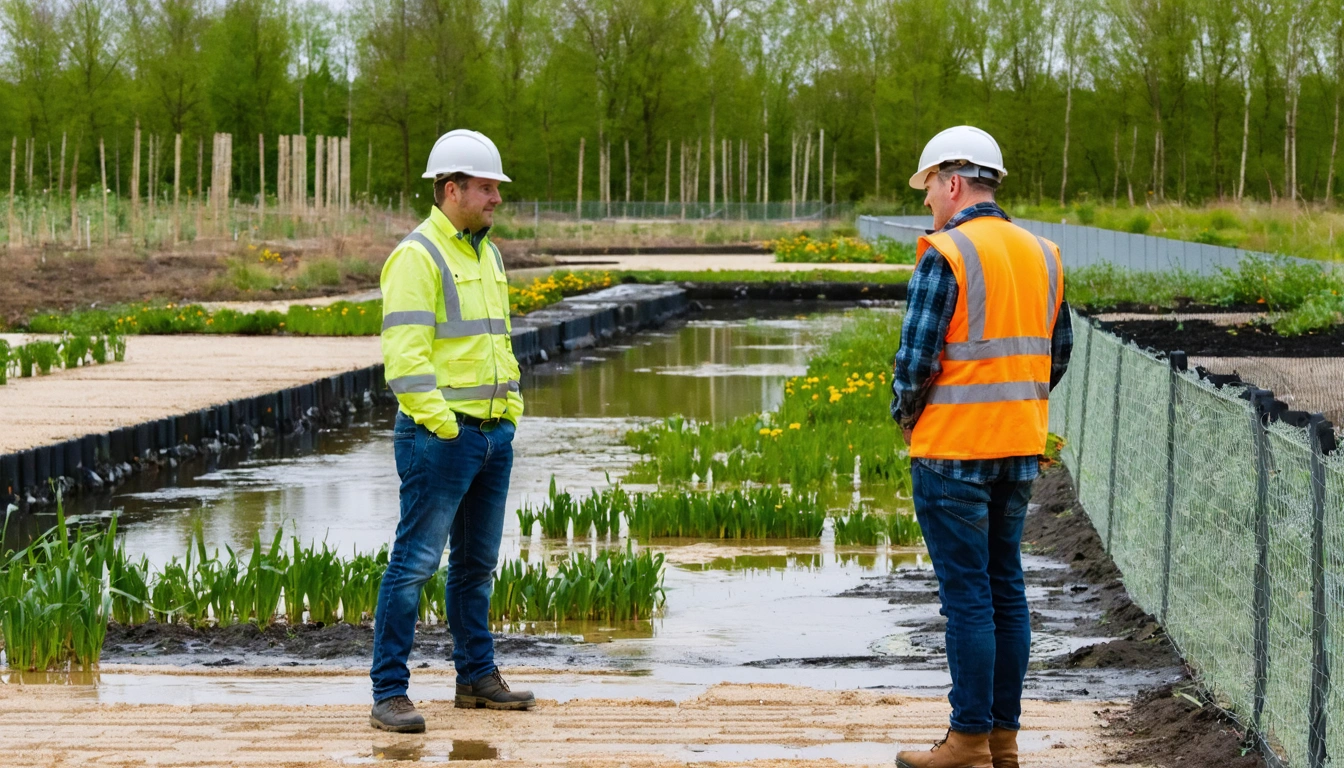
Sustainable drainage systems will be central to the corridor’s development. Swales, attenuation basins, permeable paving, rain gardens, wetlands, green roofs, and tree pits can slow runoff, improve water quality, and provide amenity value.
From site drainage to catchment level water strategy
A common weakness in development planning is treating drainage on a site by site basis. In a growth corridor of this scale, that approach is unlikely to be sufficient.
Catchment based engineering will require close collaboration between local authorities, water companies, the Environment Agency, drainage boards, developers, and infrastructure designers. This may include strategic flood storage, river restoration, culvert removal, wetland creation, natural flood management, and upgrades to wastewater treatment works.
Ground conditions will also influence water strategy. The corridor includes a range of soil types, groundwater conditions, and historic land uses. Infiltration drainage may be appropriate in some locations but unsuitable in others due to clay soils, contamination risk, high groundwater, or proximity to sensitive receptors.
Utilities, Energy Networks, and Digital Infrastructure
The Oxford to Cambridge corridor is expected to support sectors with intensive infrastructure requirements. Life sciences laboratories, clean technology facilities, advanced manufacturing plants, research campuses, and data driven businesses often require high quality power supply, resilient communications, specialist servicing, and reliable water and wastewater capacity.
Electricity demand is likely to increase significantly as buildings decarbonise, transport electrifies, and industrial processes shift away from fossil fuels. New housing and employment areas will need grid connections, substations, cable routes, electric vehicle charging, and potentially local energy systems such as heat networks, battery storage, solar generation, and smart grid technologies.
Digital infrastructure is also a core part of the corridor’s civil engineering agenda. High capacity fibre networks, 5G infrastructure, data connectivity, and resilient ducting routes are essential for research institutions, technology businesses, remote working, intelligent transport systems, and public services.
Coordinating buried services to reduce cost and disruption
One of the most practical but often underestimated challenges in large scale development is the coordination of buried services. Water mains, sewers, gas infrastructure, electricity cables, telecoms ducts, district heating pipes, drainage runs, and tree root zones all compete for limited space within streets and verges.
The corridor provides an opportunity to adopt better utility planning from the beginning. Shared service corridors, accurate digital mapping, building information modelling, and early engagement with statutory undertakers can reduce risk during construction.
Resilience should be a guiding principle for utility design. Extreme heat, flooding, power outages, cyber risks, and supply interruptions can all affect infrastructure performance. Critical facilities such as hospitals, laboratories, transport hubs, and emergency services may require enhanced redundancy and protection.
Low Carbon Construction and the Net Zero Infrastructure Challenge
The scale of construction proposed across the Oxford to Cambridge corridor means embodied carbon will be a major issue. Civil engineering projects traditionally require large quantities of concrete, steel, asphalt, aggregates, and earthworks, all of which carry carbon impacts.
Low carbon civil engineering begins with questioning the need, scale, and specification of assets. Avoiding unnecessary construction is often the most effective carbon reduction measure.
Construction logistics will also affect carbon outcomes. Major works across a wide corridor could generate substantial HGV movements, material imports, spoil exports, and temporary traffic disruption.
Designing infrastructure for whole life performance
Net zero delivery is not only about reducing construction emissions. Infrastructure must also perform efficiently over its full life. Roads, bridges, drainage systems, public spaces, utilities, and transport facilities should be designed for durability, adaptability, and low maintenance burden.
Whole life thinking will be especially important where assets are expected to support long term growth. Bridges may need to accommodate future active travel links or utility routes.
Procurement models can reinforce or undermine this approach. If contracts reward lowest capital cost without considering carbon, resilience, and maintenance, projects may miss opportunities for better long term value.