Choosing paving materials for a busy commercial site is not simply a matter of appearance or initial cost. Car parks, service yards, retail parks, logistics hubs and pedestrian areas must withstand repeated loading, surface water, changing weather and ongoing maintenance without becoming unsafe or disruptive.
I believe the best results come from assessing how the space will actually be used before comparing products. A paving material that performs well in a pedestrian plaza may be unsuitable for an access road used by delivery vehicles, even if both surfaces look similar when first installed.
Start with the demands placed on the surface
Traffic type, frequency and weight should shape the specification from the outset. A commercial footway may experience thousands of daily users but relatively little structural loading, while a service yard must cope with heavy goods vehicles, turning movements and concentrated wheel loads. These different pressures influence the required paving material, unit thickness, laying course and sub-base design.
It is also important to identify where vehicles will brake, turn, queue or remain stationary. These areas tend to deteriorate faster because horizontal forces and repeated loading can cause rutting, movement or surface deformation. Loading bays, entrances and tight junctions often need a more robust construction than quieter parts of the same site.
Consider every form of traffic
Commercial areas rarely serve just one type of user. Cars, delivery vehicles, refuse lorries, forklifts, cyclists and pedestrians may all share or cross the same space. I recommend mapping these movements early because it helps identify conflict points and areas where skid resistance, clear visual contrast or additional structural strength will be particularly important.
Future use matters too. Specifying a surface only for current traffic levels can create costly problems if the site expands or its operations change. Allowing a sensible margin for heavier vehicles or increased traffic can extend service life and reduce the need for premature reconstruction.
Compare performance rather than appearance alone
Asphalt, concrete, block paving and natural stone can all be suitable for high-traffic commercial paving, but each offers a different balance of durability, installation speed, maintenance and visual quality. Asphalt provides a continuous surface and can be installed efficiently across large areas. Concrete offers high load-bearing capacity, while concrete blocks can provide strong performance alongside easier access to underground services.
Natural stone is often selected for prominent public spaces because of its character and long service life. However, its suitability depends on factors such as stone type, thickness, finish and installation quality. No material should be chosen purely from a sample board because real-world performance depends on the complete pavement construction, not just the visible surface.
Assess whole-life value
The lowest purchase price does not always deliver the lowest long-term cost. Commercial paving may require cleaning, joint maintenance, localised repairs or resurfacing during its service life. These activities can also interrupt access, affect tenants and create temporary safety risks, so maintenance requirements should form part of the financial comparison.
I would consider expected lifespan, repairability, material availability and the practical cost of closing parts of the site. A paving system that costs more initially may offer better whole-life value if it remains serviceable for longer and can be repaired quickly without replacing a large surrounding area.
Design the full pavement construction
The visible paving material is only one part of the system. In my experience, many apparent surface failures are actually caused by weaknesses lower down, such as an unsuitable subgrade, inadequate sub-base depth, poor compaction or ineffective drainage.
A pavement must distribute traffic loads safely into the ground beneath it. The required construction depth will depend on ground conditions, expected axle loads, traffic frequency and the strength of the chosen surfacing. Site investigation and pavement design are therefore essential for heavily trafficked areas, particularly where the existing ground is variable or has previously been disturbed.
Do not underestimate the subgrade
Soft, wet or inconsistent ground can lead to settlement, cracking and depressions, regardless of the quality of the paving above it. Testing the subgrade helps establish its bearing capacity and whether improvement measures are required. These might include excavation and replacement, stabilisation, geotextiles or geogrids.

Utilities and former trenches also deserve close attention. Poorly reinstated service trenches can settle differently from the surrounding pavement, creating dips that hold water and become uncomfortable or hazardous for users. Coordination with utility providers before paving begins can reduce the likelihood of newly completed areas being excavated again.
Specify suitable laying and jointing materials
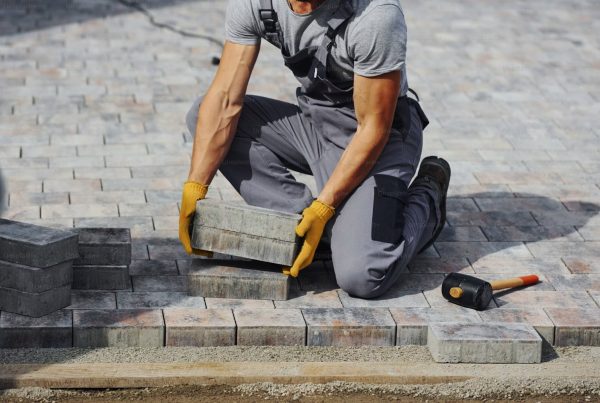
For modular paving, the laying course and joints are critical to load transfer and stability. Incorrect bedding thickness, weak edge restraints or poorly filled joints can allow blocks and slabs to move under turning vehicles. This often appears first as widening joints, rocking units or localised rutting.
The jointing material must also suit the environment. Areas exposed to mechanical sweeping, pressure washing or fuel spillages may need a different solution from a lightly used pedestrian space. Loading bays and vehicle turning zones frequently require particularly robust detailing.
Plan drainage from the beginning
Water is one of the biggest threats to commercial paving. Standing water can reduce skid resistance, enter joints, weaken underlying layers and accelerate freeze and thaw damage. Puddles around entrances and pedestrian crossings also create an immediate inconvenience for staff, visitors and customers.
Falls, channels, gullies and drainage connections should be coordinated with the proposed paving system. It is not enough to show a few drainage points on a plan. The finished levels must guide water towards them without creating abrupt gradients, inaccessible routes or low spots.
Consider permeable paving where appropriate
Permeable paving can help manage surface water close to where rain falls. Water passes through enlarged joints into a specially designed sub-base, where it may be stored temporarily, infiltrated into the ground or released at a controlled rate.
However, permeable paving is not simply standard block paving with different joints. The surface units, jointing aggregate, bedding layer and sub-base must operate as one system.
Some operational areas may not be suitable for direct infiltration. For example, yards with a significant risk of oil or chemical spills may require containment and treatment measures.
Prioritise safety and accessibility
A commercial surface must remain safe in wet weather and throughout its working life. Slip and skid resistance should be appropriate for the users, gradients and likely contaminants.
Highly polished materials can become slippery, while heavily textured finishes may be uncomfortable for wheelchair users or difficult for trolleys. The aim is to achieve sufficient grip without creating unnecessary resistance, vibration or trip hazards.
Create clear and inclusive routes
Pedestrian routes should be easy to identify and should avoid unnecessary conflict with vehicles. Contrasting colours and textures can help define crossings, footways, loading areas and vehicle lanes, although visual distinction should not be used as a substitute for good layout design.
Level changes, kerbs, tactile paving and crossing points must be considered together. Flush surfaces can improve accessibility, but they also require clear delineation and careful drainage.
Account for winter conditions
Commercial sites must often remain operational during cold weather. Materials should be suitable for repeated freezing, thawing and de-icing where these conditions are expected. Porous or damaged units may absorb water and deteriorate when temperatures fall.
The maintenance team should also know which de-icing products and snow-clearing methods are compatible with the surface. Metal blades, aggressive chemicals and poorly controlled gritting can damage some finishes or dislodge jointing material.
Match materials to specific site zones
Using one paving material across an entire development may appear simple, but it is not always the most efficient approach. Different zones can be designed according to their actual loading, appearance and maintenance requirements.
Asphalt may be suitable for main circulation routes and larger car parking areas, while concrete could be used beneath loading equipment or in locations exposed to slow-moving heavy vehicles.
Strengthen high-stress locations
Vehicle entrances, roundabouts, loading docks and tight corners experience forces that straight sections do not. Heavy vehicles turning at low speed can push and twist the surface, causing displacement or rutting.
Areas where trailers are parked can also be vulnerable to concentrated loads from support legs. Similarly, waste containers and compactors can impose heavy local loads that are easy to overlook during design.
Consider exposure to chemicals and staining
Fuel stations, food service yards and industrial premises may expose paving to oils, fats, cleaning chemicals and other contaminants. These substances can soften some binders, stain porous materials or weaken jointing products.
The specification should consider chemical resistance alongside structural performance. Sealants may help in some settings, but they introduce their own maintenance requirements and can alter colour or slip resistance.
Examine installation constraints
The best technical solution still needs to be practical to build. Commercial sites often have limited working space, restricted delivery hours and a need to maintain access for customers, emergency vehicles or neighbouring businesses.
Asphalt can provide rapid coverage and may reopen relatively quickly, but it requires suitable access for paving equipment and coordinated material deliveries. Concrete may need more time for curing before it can accept traffic.
Plan phasing and temporary access
Construction sequencing should prevent completed paving from being damaged by later activities. Heavy plant, material storage and uncontrolled site traffic can mark or overload a finished surface before the site opens.
Where premises must remain operational, phased works can reduce disruption. Each phase should have safe temporary routes, clear barriers and properly detailed interfaces with existing surfaces.
Insist on workmanship and quality control
Even a strong specification can fail if installation standards are poor. Formation levels, layer thicknesses, moisture content and compaction should be checked as work progresses.

Material samples and small trial panels can resolve questions about colour, texture and laying patterns before large areas are completed. For heavily trafficked surfaces, testing and inspection should focus on structural compliance as well as appearance.
Build maintenance into the specification
Maintenance should be considered before the material is selected, not after defects appear. The person responsible for the completed site needs to know how the paving should be inspected, cleaned and repaired.
Regular inspections can identify blocked drainage, missing jointing material, loose units, cracks and local settlement before they develop into larger failures. Prompt local repairs are usually less disruptive and less expensive than waiting until the pavement becomes unsafe.
Choose materials that can be repaired efficiently
Utility access is a major consideration in commercial areas. Modular paving can often be lifted and reinstated, provided matching replacement units are available and the work is completed properly.
Concrete repairs may require saw cutting, removal, curing time and temporary closures. Where access cannot be interrupted easily, this downtime may have a greater financial impact than the repair cost itself.
I recommend keeping a stock of matching blocks, slabs or stone from the original project. Colours and product ranges change over time, and finding an exact match several years later can be difficult.
Prepare a realistic cleaning regime
Cleaning methods should suit the surface and the type of contamination expected. Excessive pressure washing can remove jointing material, while harsh chemicals may discolour paving or damage sealants.
A clear maintenance plan should state the approved cleaning products, equipment and inspection intervals. This protects the paving, supports drainage performance and helps facilities teams respond consistently to spills and defects.
Make the final selection using evidence
Before specifying a material, compare structural capacity, slip resistance, drainage performance, repair options, installation time and whole-life cost. Product data, test results, reference projects and trial areas provide far more useful evidence than appearance alone.
The final choice should also reflect the contractor’s ability to install the system correctly and the operator’s capacity to maintain it. A technically advanced surface offers little value if specialist repairs or routine upkeep cannot be delivered reliably.
Use a practical selection checklist
I would confirm the expected traffic loads, ground conditions, drainage strategy, accessibility requirements and exposure to contaminants. I would then assess construction phasing, maintenance access, replacement material availability and the consequences of future closures.
High-traffic commercial paving performs best when every layer and detail is designed around real site use. Choosing materials on that basis creates safer, more durable surfaces and reduces expensive disruption throughout the pavement’s service life.