Enabling works are often treated as the preliminary tasks that happen before the “real” construction begins. In practice, they can determine whether an infrastructure or civil engineering project starts safely, stays on programme and avoids expensive surprises once major operations are under way.
Why early preparation deserves strategic attention
Enabling works form the bridge between design intent and practical delivery on site. Depending on the project, the scope may include surveys, utility diversions, demolition, vegetation clearance, earthworks, temporary drainage, haul roads, site compounds and environmental controls.
A weak enabling phase can expose teams to unidentified services, contaminated ground, restricted access or unsuitable working platforms. These issues frequently cause delays because they affect labour, plant movements, permits and subsequent trades at the same time.
Define what “site ready” means
One of the most useful early decisions is to establish an agreed definition of site readiness. This should be specific and measurable. For example, it may require particular access routes to achieve a stated bearing capacity, known utilities to be isolated or protected, designated areas to be cleared, and temporary drainage to be operational before bulk excavation starts.
This definition should be developed with input from designers, contractors, utility specialists, environmental advisers and the client team. A shared set of readiness criteria reduces ambiguity between work packages and helps prevent assumptions about who is responsible for temporary measures, residual hazards or incomplete information.
Treat interfaces as project risks
Most enabling works problems occur at interfaces. A utility diversion may depend on third party approvals, demolition may reveal undocumented structures, and earthworks may be constrained by ecological requirements or material classification.
An interface register can help the team record each dependency, the parties involved, the information required and the date by which a decision must be made.
Build the plan around evidence from the site
Reliable planning starts with a robust understanding of the existing site. Historic drawings and asset records are useful, but they should not be accepted as complete or accurate without verification.
Prioritise surveys according to risk
Not every part of a site requires the same level of investigation. Survey resources should be directed towards locations where uncertainty could have the greatest safety, programme or cost impact.
Record assumptions and information gaps
Some uncertainty will remain even after proportionate investigation. The important step is to document it clearly. Assumptions should state what is believed to be true, the evidence supporting that belief and the consequences if conditions differ on site.
Known gaps should be linked to actions such as further surveys, trial holes or controlled opening up works. They should also be reflected in risk allowances and the construction programme.
Turn the scope into a buildable sequence
The sequence should be tested against the planned methods for the permanent works.
Work backwards from critical operations
A practical way to build the sequence is to start with the first critical permanent operation and work backwards. If piling is the first major activity, the project team should identify what must be completed before the piling rig arrives.
Each requirement can then be linked to its predecessor activities, approvals and inspection points. Working backwards in this way helps distinguish genuinely essential enabling works from tasks that could be completed later without affecting the critical path.
Allow for changing site conditions
Construction sites rarely remain static. Traffic routes, storage areas and exclusion zones may need to change as work progresses. The enabling plan should therefore cover key phases rather than showing only the initial site arrangement.
Phased logistics drawings can be particularly helpful on constrained sites. They allow teams to test whether delivery vehicles can turn safely, whether emergency access remains available and whether pedestrians can be segregated from plant throughout the project.
Plan utility management before excavation begins
The plan should identify which services will remain operational, which require protection and which must be diverted or disconnected. It should also define who has authority to approve isolations and how service status will be communicated to people working on site.
Use verification methods appropriate to the risk
Detection surveys provide valuable information, but they do not remove the need for safe excavation practices. Trial holes may be required to confirm the depth, alignment and material of critical services.
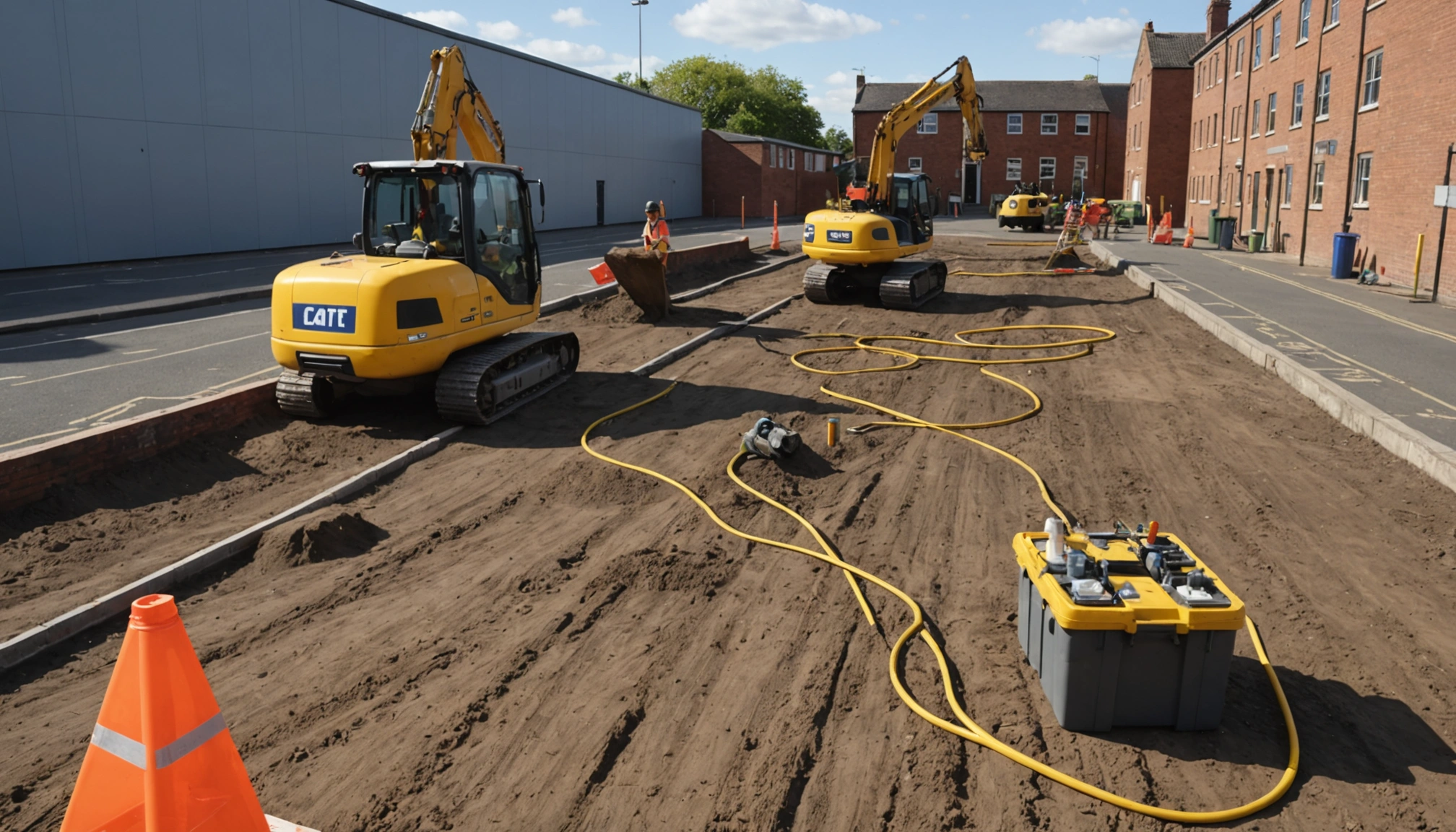
Survey findings should be transferred into coordinated drawings and setting out information that can be used by site teams. Markings on the ground are useful, but they can fade, become obscured or be removed as work progresses.
Account for third party lead times
Diversions and disconnections often depend on statutory undertakers or specialist providers. Their quotation, design, approval and delivery periods can be considerably longer than the physical site work.
The programme should include dates for applications, surveys, design acceptance, payment, permits and attendance on site. It should also allow for potential outages, traffic management restrictions and customer notification requirements.
Integrate temporary works into the enabling strategy
Temporary works are often fundamental to safe site preparation. Working platforms, excavation support, temporary bridges, haul roads, edge protection and drainage measures all need an appropriate level of design, checking and control.
The project team should identify temporary works requirements while the enabling scope is being developed, not after plant and labour have been mobilised. Early identification allows design assumptions to be checked against actual ground conditions, loading requirements and the proposed construction sequence.
Define loads and performance requirements
A temporary feature cannot be designed effectively without understanding how it will be used. A working platform may need to support piling rigs, cranes or loaded dump trucks, each of which creates different loading conditions.
Performance requirements should cover more than structural capacity. Drainage, surface condition, maintenance, inspection frequency and safe access may be equally important. Where platform certificates or formal permits are required, the plan should state who issues them and what evidence must be available first.
Make inspection and maintenance visible
Temporary works can deteriorate during use. Heavy traffic may rut a haul road, rainfall may soften formation layers and excavation support may be affected by changing ground or water conditions.
The enabling plan should define inspection responsibilities, trigger points and reporting procedures. Severe weather, impact damage, changes in loading or nearby excavation may all justify an additional inspection.
Control earthworks, water and materials together
Earthworks planning should consider excavation, treatment, storage, reuse and disposal as connected activities. Looking at them separately can result in unnecessary handling, poorly located stockpiles and avoidable off-site transport.
An early earthworks balance helps the team compare expected cut and fill quantities. However, volume alone does not determine whether material can be reused. Suitability depends on factors such as moisture content, grading, contamination, geotechnical properties and the specification for the receiving area.
Establish a clear materials strategy
The materials strategy should identify how excavated soils will be classified, where they can be stored and what testing is needed before reuse. Stockpiles should be located away from sensitive boundaries, drainage routes and areas required for later construction.
Segregating material types can preserve reuse options and prevent clean soils from being mixed with unsuitable or contaminated material. The site should also maintain appropriate records of movements, test results and disposal documentation.
Design temporary drainage for real site conditions
Temporary drainage is frequently underestimated during early planning. Exposed ground, compacted access routes and unfinished surfaces can generate substantial runoff, particularly during prolonged rainfall. Without effective controls, water can damage working areas, mobilise silt and delay excavation.
The drainage plan should consider collection points, settlement measures, discharge locations and the capacity required during each construction phase. Pumps, settlement tanks and silt controls need suitable access for inspection and maintenance.
Build environmental controls into the method of work
Environmental controls are most effective when they shape the construction method rather than being added after decisions have been made. Ecology, noise, dust, vibration, water quality and waste requirements can all influence the timing and sequence of enabling activities.
Vegetation clearance provides a common example. The work may appear straightforward, but nesting birds, protected species or invasive plants can introduce seasonal restrictions and specialist supervision requirements.

Translate assessments into site controls
Reports and management plans need to result in clear actions for supervisors and operatives. Dust controls might include dampening, road cleaning, covered loads and speed restrictions.
Controls should be proportionate to the site and the activity. They should also be inspected and adjusted as conditions change. A water suppression arrangement that works in mild weather may be ineffective during a dry, windy period, while excessive water use can create runoff or poor ground conditions.
Prepare for unexpected contamination
Even where investigations have been completed, previously unidentified contamination may be encountered. The project should have a clear discovery procedure covering work stoppage, area isolation, notification, sampling and material management.
Site teams need to understand the warning signs, which might include unusual odours, staining, buried drums, ash deposits or unexpected made ground. A rapid and controlled response protects workers, prevents material from being spread and allows specialist advice to be obtained before excavation continues.
Design safe and efficient site logistics
Good logistics planning reduces conflict between deliveries, plant, pedestrians and neighbouring road users. It begins with an accurate understanding of access restrictions, vehicle dimensions, delivery frequency and the space needed for unloading and turning.
Separate people and plant wherever possible
Physical segregation is generally more reliable than relying solely on signs and individual awareness. Pedestrian routes should be direct, well maintained and protected from vehicle movements.
Where reversing cannot be eliminated, the plan should provide controlled manoeuvring areas and trained vehicle marshals. Lighting, barriers and route markings must remain effective during poor weather and changing site conditions.
Coordinate deliveries and storage
Delivery schedules should reflect available storage space, lifting capacity and the progress of site activities. Just-in-time deliveries can reduce congestion, but they require dependable suppliers and careful coordination.
Materials should be stored on stable ground without obstructing emergency routes, drainage systems or future work areas. Hazardous products, fuels and gases require appropriate segregation, containment and security.
Set clear controls for procurement and mobilisation
Enabling works packages should define scope boundaries, design responsibilities, exclusions and required outputs. Ambiguous package information often leads to duplicated work, missed activities and disputes over temporary measures.
Procurement should assess capability as well as price. Relevant experience, supervision, plant availability, temporary works competence and environmental performance are particularly important when the work involves uncertain ground or live infrastructure.
Use mobilisation readiness checks
Before work starts, the team should confirm that designs, permits, surveys, welfare facilities, emergency arrangements and approved methods are in place. Plant certification, operator competence and material availability should also be verified.
A readiness review provides a formal opportunity to challenge unresolved assumptions. Any outstanding item should have an owner, deadline and clearly understood effect on the planned start.
Measure progress against readiness outcomes
Progress should not be measured only by quantities cleared, excavated or demolished. The more useful question is whether each area is ready for its next operation.
Area-based handover records can capture survey information, inspection results, utility status, temporary works certification and remaining restrictions. Photographs and updated drawings provide a valuable record of conditions before later activities conceal them.
Plan for handover from the beginning
Handover requirements should be agreed when the enabling scope is prepared. This ensures contractors collect the correct evidence while work is being completed rather than attempting to reconstruct it afterwards.
A structured handover should identify completed work, residual hazards, temporary features that require maintenance and any assumptions passed to the next contractor. With those controls in place, enabling works become a managed transition into construction rather than a loosely defined preliminary phase.